

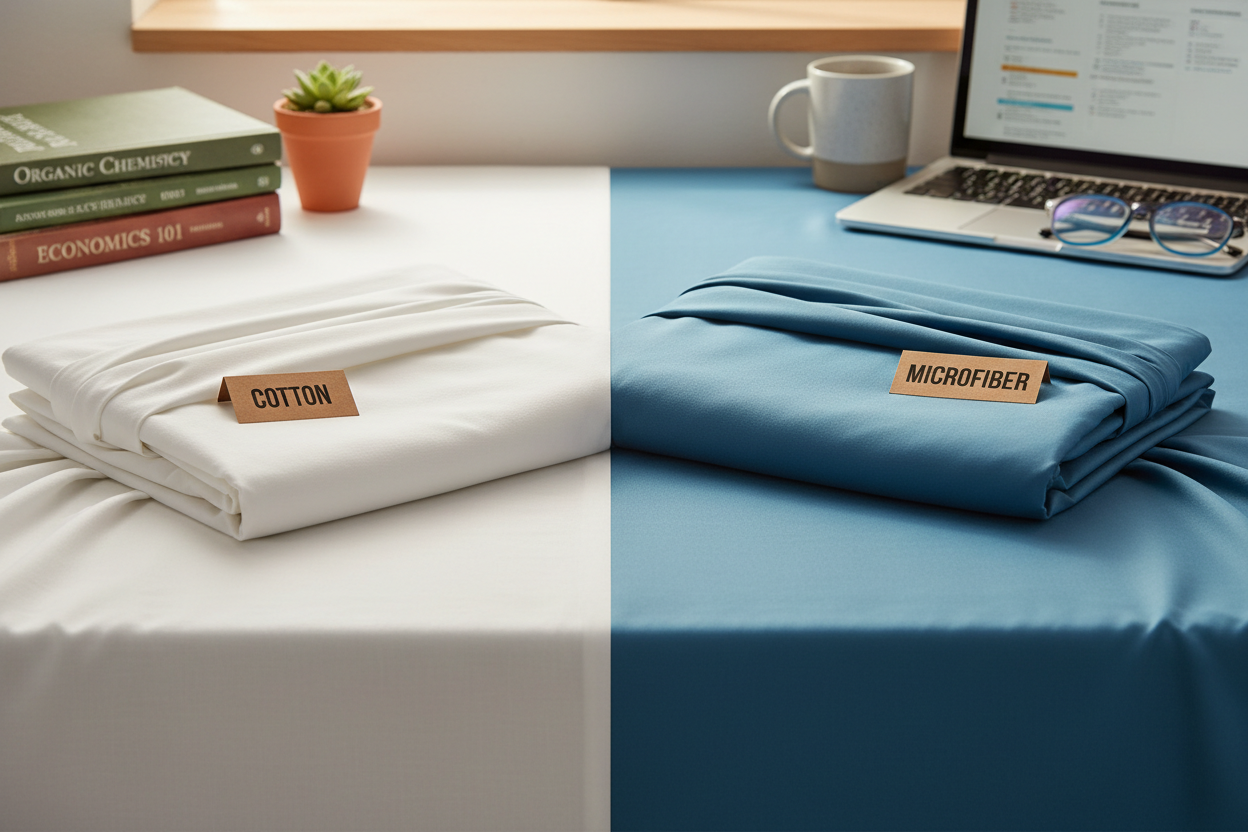
Cotton vs Microfiber Sheets: Which Wins for Dorm Sheets?
Cotton wins for dorm sheets in almost every real-world test - feel, durability, and how the fabric holds up over a full school year of washing. Microfiber sheets are cheaper up front, but they pill faster, trap heat against the skin, and shed synthetic fibers with every wash. If you're comparing cotton vs microfiber sheets for a dorm room, the difference shows up most in month three, not day one. For a closer side-by-side, the Microfiber vs Cotton Sheets: 7 Key Differences You Must Know guide walks through each fiber in more detail.
This guide focuses specifically on dorm sheets - the smaller Twin XL sizing, the shared-laundry-room reality, and the fact that these sheets need to survive move-in day, midterms, and everything spilled in between. We'll cover:
- What actually separates cotton from microfiber at the fiber level
- How each fabric feels against skin during a warm dorm-room night
- Why microfiber's biggest drawback isn't comfort - it's what it releases in the wash
- How to pick the right cotton dorm bedding for a Twin XL dorm bed
- Care steps that keep dorm sheets looking new past the first semester
Quick Answer: Cotton vs Microfiber Sheets for Dorm Beds
If you only have thirty seconds: choose cotton. Natural cotton fibers are more breathable, get softer with every wash instead of pilling, and hold up better under the frequent, sometimes-neglected laundry schedule of dorm life. Microfiber sheets feel silky when new, but that feel fades fast, and the fabric is 100% synthetic plastic - not something a natural-fiber brand like California Design Den will recommend, even as a budget pick.
For dorm sheets specifically, the practical answer is: a 100% Cotton Bedding Set in a lower thread count (400TC) gives you the breathable, easy-care option that fits a dorm budget without switching to synthetic fiber.
The reasoning holds up whether you're outfitting a first-year dorm bed or replacing a worn-out set halfway through the year. Cotton fiber is stronger under repeated washing, more forgiving of a communal dryer's heat, and simply feels better against skin over time - three things microfiber struggles with once the newness wears off.

What's the Difference Between Cotton and Microfiber Sheets?
The difference starts with what the fiber actually is. Cotton is a natural plant fiber, grown and harvested, then spun into yarn and woven into fabric. Microfiber is a synthetic textile, made from ultra-fine strands of plastic - typically polyester or a polyester-nylon blend - extruded through machinery rather than grown.
That single distinction - natural versus synthetic - is what drives almost every difference that follows: how the fabric breathes, how it ages, how it washes, and what it leaves behind in the water supply.
How Cotton Sheets Are Made
Cotton sheets start as raw cotton fiber, which is cleaned, carded, and spun into yarn. Long-staple cotton fibers produce a smoother, stronger yarn than short-staple cotton, which is why fiber length matters as much as thread count. That yarn is then woven - usually in a sateen or percale weave - into the finished sheet. Sateen has a one-under, three-over weave pattern that creates a smooth, subtly lustrous surface. Percale uses a simple over-under weave for a crisper, more matte finish. Both are 100% natural cotton; the weave just changes the handfeel.
Single-ply yarn construction matters here too. A single-ply yarn made from long fibers is stronger and smoother than a cheaper multi-ply yarn spun from short, broken fibers - even at the same thread count. That's part of why two sheet sets with an identical thread count number can feel completely different once you actually sleep on them.
How Microfiber Sheets Are Made
Microfiber starts as a petroleum-based polymer, melted and extruded through spinnerets into extremely thin synthetic filaments - far thinner than a human hair. Those filaments are woven or knit into fabric. Because the fibers are so fine, microfiber can feel smooth right out of the package. But synthetic fiber doesn't behave like cotton over time. It doesn't get softer with age - it tends to pill, and it holds onto body heat rather than releasing it.
Manufacturing cost is the main reason microfiber shows up so often in budget bedding. Synthetic filament production is cheaper and faster to scale than growing and processing natural fiber, which is why microfiber sheets are usually priced lower than cotton at the same size. That upfront savings is real - it just tends to disappear once you factor in how much sooner a microfiber set needs replacing.
Cotton vs Microfiber Sheets Side-by-Side
|
Factor |
Cotton |
Microfiber |
|
Fiber source |
Natural plant fiber |
Synthetic (plastic-based) |
|
Feel over time |
Softens with every wash |
Tends to pill and thin out |
|
Breathability |
Open weave, airy feel |
Denser weave, traps heat against skin |
|
What it sheds in the wash |
Natural lint only |
Microplastic particles |
|
Typical dorm lifespan |
Multiple school years with care |
Noticeable wear within a semester or two |
|
Price point |
Mid-range to higher-end |
Usually lower upfront cost |

Cotton vs Microfiber Sheets: Feel and Comfort Compared
Feel is where most dorm shoppers make their decision, and it's also where the two fabrics diverge the most once you look past the first night. A sheet set that feels great on day one but rough by week six isn't actually the better deal - it just delays the disappointment.
A cotton sheet set, like the Everyday Ease 400 Sateen Cotton Sheet Set in white, has a lightweight handfeel with a soft, silky glide that stays smooth wash after wash. That's a real, testable property of long-staple cotton - the fibers loosen slightly with each laundry cycle, which is why cotton sheets are famous for getting better with age instead of worse.
Microfiber starts soft but moves in the opposite direction. The synthetic filaments are prone to friction pilling, especially under the higher wash frequency dorm sheets go through. What felt silky in September can feel rougher and thinner by winter break.
How Each Fabric Feels in Warm Weather
Dorm rooms are notorious for inconsistent temperature control - some buildings run warm, and many don't have personal air conditioning. This is where weave and fiber structure matter more than marketing claims. Natural cotton has an open fiber structure that lets air move through the fabric, so it feels lighter and more breathable against skin on a warm night. Microfiber's dense, synthetic weave sits closer to the body and traps warmth rather than letting it move through, which is part of why it can feel clammy after a few hours of sleep.
Cotton vs Microfiber Sheets: Durability and Wash Care
Dorm laundry is not gentle. Shared machines, inconsistent water temperatures, and infrequent washing all put extra stress on fabric. Cotton fiber is naturally resilient to this kind of wear - it can handle regular washing without losing structural integrity, and the fabric actually becomes more comfortable with use. Microfiber's synthetic fibers are more sensitive to heat and friction, which is exactly what a communal dryer delivers in abundance.
The Microplastics Problem with Microfiber
Beyond feel and durability, there's a bigger reason a natural-fiber brand won't put microfiber on a recommended list: what it releases into the water.
Microfiber is made from synthetic plastic fibers. Every wash cycle releases tiny microplastic particles into the water - and those particles can also transfer onto skin during wear. Natural cotton doesn't shed plastic in the wash. For a dorm room, where laundry happens in shared, high-volume machines, that difference adds up across an entire floor of students doing laundry every week. It's a meaningful distinction for your room and for what goes down the drain.
This is one reason California Design Den has never made a synthetic sheet. Every collection, including the Cotton Bedding Set, is built from 100% natural cotton - no microfiber, no plastic fill, and nothing synthetic shedding into the wash.
It's a detail that's easy to skip when comparing prices at move-in, but a dorm floor doing weekly loads of laundry adds up to a lot of wash cycles across a semester. Choosing a natural fiber over a synthetic one at that scale is a small decision with a real cumulative effect - for the room, and for what ends up in the wastewater afterward.
Why Dorm Sheets Need to Handle More Than Regular Bedding
Dorm sheets deal with a different level of daily wear than sheets in a regular bedroom. Between move-in stress-testing, shared laundry rooms, snack spills, and a schedule where laundry might happen every three weeks instead of every week, dorm sheets need to be forgiving. Cotton dorm bedding handles that kind of use well - it doesn't need special detergent, it tolerates hot dryers better than synthetic fiber, and it holds its shape and softness through repeated cycles.
Cotton dorm bedding also travels well. It packs down easily for move-in day, doesn't wrinkle-set the way some synthetic fabrics do after sitting in a dryer, and looks presentable without ironing - a practical detail when there's no iron in the room to begin with. Between move-in, midterms, and move-out, a cotton sheet set typically needs nothing more than a normal wash cycle to stay in good shape, which is more than can be said for a fabric that pills after a handful of hot-dryer cycles.
What to Avoid When Buying Dorm Sheets
A few materials and features consistently cause problems in dorm settings - most of them show up months after purchase, once the return window has closed:
- Microfiber as a primary material - pills faster under frequent washing and traps heat in warmer dorm rooms
- Extremely low or vague thread counts - anything unlabeled or unusually cheap often signals thin, short-staple fiber
- Sheets sized for a standard Twin instead of Twin XL - a common and avoidable dorm-shopping mistake
- Non-deep pockets - dorm mattresses, especially with a topper, often need a deeper fitted-sheet pocket than a standard Twin sheet provides
- Sheets that require dry cleaning or hand washing - impractical for shared laundry rooms
Twin vs Twin XL Dorm Sheets
Most college dorm beds use a Twin XL mattress, not a standard Twin. A Twin XL measures 38 inches by 80 inches - five inches longer than a standard Twin's 75-inch length, which matters more than it sounds like it should. A standard Twin fitted sheet will not stretch to fit a Twin XL mattress properly, so checking the sizing before ordering dorm sheets is one of the most common move-in-day mistakes to avoid.
It's worth double-checking with the specific school before ordering, too. The vast majority of U.S. dorms use Twin XL, but a small number of older buildings or international programs still use standard Twin frames. A quick measurement of the existing mattress - or a look at the housing department's furniture specs - settles the question before the sheets arrive and don't fit.

How to Care for Cotton Dorm Sheets
Cotton dorm bedding is low-maintenance in practice, which matters when a communal laundry room is involved. A few habits keep a Sheet Set performing well for the whole school year:
- Wash in cool to warm water - hot water isn't required for cotton and can add unnecessary wear over many cycles
- Skip fabric softener on sateen weaves - it can build up on the fibers and dull the natural sheen over time
- Use a lower dryer heat setting - cotton dries efficiently without maximum heat, which also protects the elastic band on fitted sheets
- Wash before first use - this softens the fabric right away and removes any manufacturing residue
- Rotate two sheet sets - having a backup set means dorm sheets can go a full wash cycle without leaving a bed bare
Cotton fiber is forgiving of an imperfect laundry routine, which is exactly what a dorm schedule usually delivers. That resilience is part of why cotton dorm bedding remains the more practical long-term choice over microfiber, which tends to show wear faster under the same conditions.
None of this requires special products or a complicated routine. A basic 100% cotton sheet set is designed to go through a normal wash-and-dry cycle without special handling, which matters when the laundry room is shared, the machines are unfamiliar, and there's rarely time to babysit a delicate cycle between classes.
Why California Design Den Cotton Dorm Sheets Are Built for Dorm Life
Good dorm sheets start with a simple outcome: falling asleep comfortably on an unfamiliar mattress, in a room you don't fully control the temperature of. That's the real reason fiber and weave matter more in a dorm than almost anywhere else - a fabric that feels heavy or traps warmth makes an already-adjustment-heavy year harder than it needs to be.
California Design Den builds every sheet set from 100% natural cotton - no synthetic microfiber, no plastic fibers, nothing shedding into the wash. The Everyday Ease 400 Sateen Cotton Sheet Set in white uses single-ply yarns from long-staple cotton fiber for a lightweight, breathable feel suited to a warmer dorm room, while the Restful Retreat 600 Sateen Cotton Sheet Set in white offers a slightly denser, more substantial feel for students who prefer that weight.
Both collections are backed by the Good Housekeeping Seal, and the Everyday Ease 400 has earned the Good Housekeeping Best Bedding Award 2026 in the Cost-Savings Cotton category - recognition that lines up with what dorm shoppers actually need: real cotton quality at a fair price. The Restful Retreat 600 also carries the Oprah Daily 2026 Sleep Award for Most Budget-Friendly, and every set in both lines is OEKO-TEX Standard 100 certified, meaning it's been tested for harmful substances.
California Design Den has stayed with 100% natural cotton across every collection - including the full Cotton Bedding Set range - because that's the fiber that actually holds up to the demands of daily use, dorm or otherwise. We own our production facility, which is part of why cotton sheets built to this standard don't carry an inflated markup. Over 8 million sleepers have chosen California Design Den cotton sheets, and for anyone comparing options before move-in day, the 100% Cotton Bedding Set collection is built specifically around that natural-fiber standard - no microfiber anywhere in the lineup.
For more on what sets natural fiber apart, the Best Cotton Sheets guide breaks down top picks across thread counts, and The Benefits of Cotton Sheets covers the full case for natural fiber bedding in more depth.
How to Choose the Best Cotton Dorm Sheets for a Twin XL Bed
Picking a Sheet Set for a dorm bed comes down to three things: the right size, a thread count that matches how the room actually feels, and a weave that suits personal preference.
Start with sizing - confirm the set is labeled Twin XL, not Twin, and check that the fitted sheet pocket depth matches the dorm mattress, especially if a mattress topper is involved. Most dorm mattresses need a 15–16 inch deep pocket to account for the extra padding many students add on top.
From there, thread count becomes a preference decision, not a quality ranking. A lower thread count works well for a first dorm setup, while a slightly heavier weave suits students who prefer a more substantial feel. If a warmer dorm room is the main concern, a lighter set like the Everyday Ease 400 is the more breathable pick; if a heavier, more substantial feel is the priority, the Restful Retreat 600 Sateen Cotton Sheet Set in white is the better fit. Either way, staying in 100% cotton means the set will hold up to weekly laundry runs far better than a synthetic alternative.
Thread Count Guide for Dorm Sheet Sets
|
Thread Count |
Feel |
Best For |
|
400TC |
Soft, smooth, airy |
Warm dorm rooms, everyday use, budget-friendly first sets |
|
600TC |
Soft, smooth, slightly denser |
Students who want a bit more substantial feel year-round |
Different thread counts offer different sleep experiences - the goal is choosing based on how the sheets feel, not just chasing the highest number on the label. For most first-year dorm setups, a 400TC cotton sateen sheet set covers the basics: breathable, easy-care, and budget-conscious without switching to synthetic fiber.

Frequently Asked Questions About Cotton vs Microfiber Sheets
Which is better, cotton or microfiber?
Cotton is better for most sleepers. It's more breathable, softens with every wash, and doesn't shed microplastics - while microfiber pills faster and traps heat.
What to avoid when buying bed sheets?
Avoid unlabeled thread counts, synthetic microfiber blends, and sizing mismatches. For dorm sheets, always confirm Twin XL sizing before ordering.
Should my bed sheets be 100% cotton?
Yes - 100% cotton sheets breathe better, age better, and avoid the microplastic shedding that comes with synthetic fabric blends like microfiber.
What type of sheets are best for dorm beds?
100% cotton sheets in a 400TC or 600TC sateen weave suit most dorm beds - breathable, durable, and sized correctly for a Twin XL mattress.
Are dorm beds a twin or twin XL?
Most dorm beds use Twin XL mattresses - 38 by 80 inches, five inches longer than a standard Twin, so standard Twin sheets won't fit properly.
Final Verdict: Cotton vs Microfiber Sheets for Dorm Beds
Cotton vs microfiber sheets isn't a close call once you factor in a full school year of use. Cotton breathes better, softens instead of pilling, holds up to shared-laundry-room wear, and doesn't release microplastic fibers into the water with every wash. Microfiber's only real advantage is a lower price tag on day one - an advantage that fades fast once the fabric starts pilling by month two or three.
For dorm sheets specifically, the practical move is a 100% cotton sateen set sized correctly for a Twin XL mattress. Whether that's the breathable, budget-friendly Everyday Ease 400 or the slightly more substantial Restful Retreat 600, natural cotton fiber is simply built to handle what a dorm room throws at it - better than any synthetic alternative can.
Move-in day is stressful enough without wondering if the sheets will hold up past October. Choosing cotton settles that question before it starts.


