

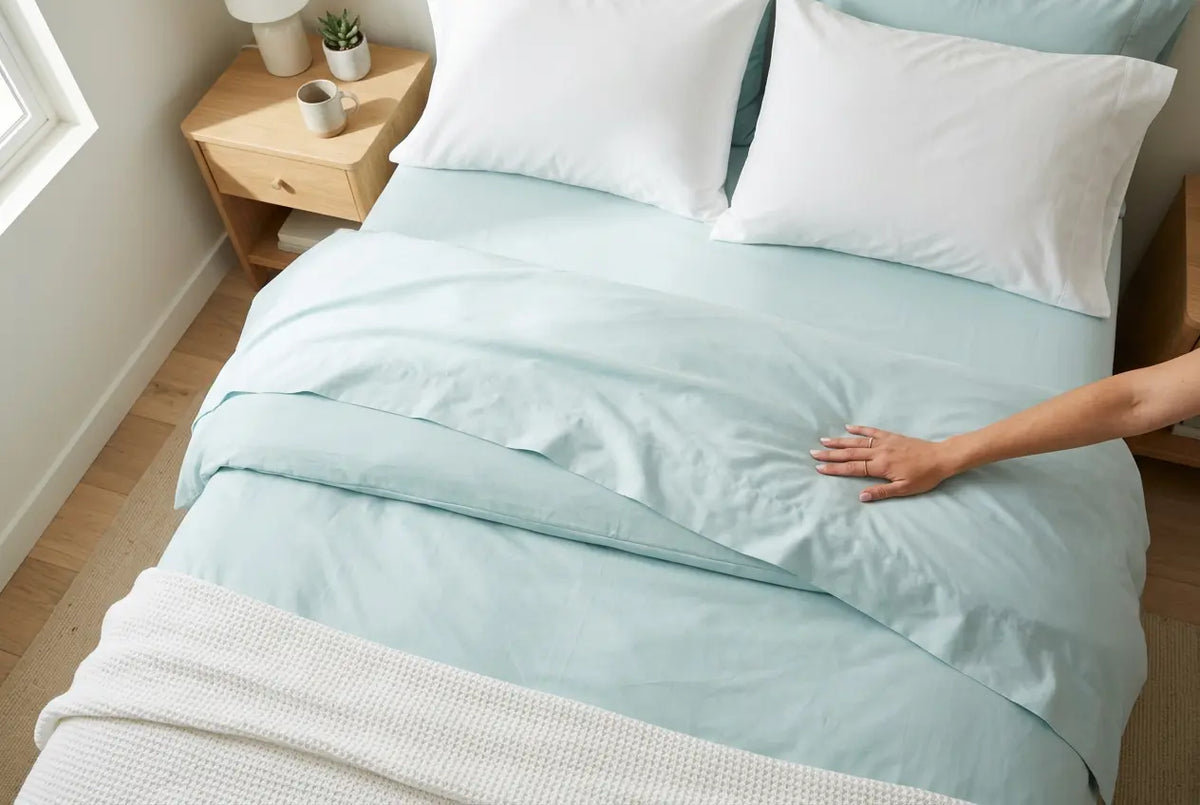
Best material for bed sheets to stay cool: a fabric guide
The best material for bed sheets to stay cool is a breathable fiber woven into a light, open fabric. Our guide Percale vs linen: which sheet fabric suits how you sleep? compares two of the fabrics that fit that description. Linen, Viscose from Bamboo, lyocell and cotton percale each pair an airy fiber with a construction that lets air move through the sheet.
Three things decide how a sheet feels on a warm night: the fiber, the weave and the weight of the fabric. A fiber with an open, airy hand, a weave with room between the threads and a light weight on the skin add up to a bed that feels fresh rather than heavy. Change any one of the three and the feel changes with it. That is why two sheets spun from the same fiber can feel very different once they are on the bed.
As a family-owned cotton bedding brand, California Design Den writes this guide from the cotton side of the bed. We have included fabrics we do not make, such as linen and lyocell, so the comparison stays fair and useful. Below you will find a quick comparison table, a closer look at each fiber, the two cotton weaves we make, and a simple way to choose the feel that suits how you sleep.
Quick answer: the best material for bed sheets to stay cool
Choose a breathable fiber, an open weave and a light weight. Linen, Viscose from Bamboo and lyocell have a cool, airy hand. Cotton percale feels crisp, matte and airy. Cotton sateen feels smooth and silky with a gentle sheen, and it suits sleepers who prefer a smoother glide.
Sheet fabric comparison at a glance
|
Fabric |
Fiber type |
Weave |
Feel on the skin |
Weight |
Good to know |
|---|---|---|---|---|---|
|
Linen |
Flax plant fiber |
Loose, textured weave |
Airy, dry, relaxed texture |
Light to medium |
Wrinkles easily and has a lived-in look |
|
Viscose from Bamboo |
Semi-synthetic regenerated fiber |
Varies by product |
Cool, smooth, silky-smooth drape |
Lightweight |
Care varies, so follow the label |
|
Lyocell |
Regenerated wood-pulp fiber |
Varies by product |
Smooth, cool hand with soft drape |
Lightweight |
Often sold under brand names |
|
Cotton percale |
100% cotton |
One-over-one-under |
Crisp, matte, airy |
Lightweight |
Matte finish with an open structure |
|
Cotton sateen |
100% cotton |
Four-over-one-under float |
Smooth, silky, gentle sheen |
Varies by thread count |
More drape and a soft sheen |
|
Polyester blends |
Petroleum-based synthetic |
Often tightly woven |
Slick, can feel close on the skin |
Light |
Check the fiber content on the label |
How to use this comparison
Read the table across a row, not down a column. It describes feel and fit, so no fabric is scored or ranked against another. Use it in three steps:
- Pick the surface you like: crisp and matte points to percale and linen, while a smooth drape points to sateen, lyocell and Viscose from Bamboo.
- Check the weight: a lighter fabric rests more gently on the skin on a warm night.
- Confirm the fiber content on the label, since the fiber sets the base feel of every sheet.
There is no one fabric that wins for every sleeper, because feel is personal. Some people want a sheet that feels crisp and matte, like a freshly pressed shirt. Others want a sheet that slides over the skin with a soft drape. Both preferences can lead to a light, airy bed, which is why the table lists several good options rather than one.
Fiber, weave and weight: what shapes how a sheet feels
How a sheet feels on a warm night comes down to three choices made before the fabric ever reaches your bed. The fiber sets the base feel, the weave decides how open the fabric is, and the weight decides how much fabric rests on you.
Fiber: the starting point for an airy feel
Fiber is what the yarn is spun from, and each fiber brings its own hand to the bed:
- Plant fibers such as cotton and linen have a soft, dry hand on the skin.
- Regenerated fibers such as lyocell and Viscose from Bamboo tend to feel smooth, with a soft drape.
- Synthetic fibers such as polyester are made from petroleum, and a tightly woven polyester sheet can feel slick and close against the skin.
Long-staple and extra-long staple cotton produce smoother, stronger yarn, and that shows up as a smoother surface on the bed. Staple length is the length of each individual cotton fiber, and a longer staple means fewer fiber ends on the surface of the yarn. Synthetic sheets raise a separate question beyond feel. Microfiber sheds plastic every wash, which is worth weighing alongside comfort when you compare a synthetic set with a cotton one.
Weave: open structures versus closer ones
Weave is the pattern the threads follow, and it decides how much room sits between them. A loose or open weave, like the textured weave of linen or the one-over-one-under structure of percale, leaves space for air to move. A closer weave, like a sateen float, puts more yarn on the surface and feels smoother, with more drape and a gentle sheen.
Neither structure is better than the other. Each one suits a different preference, and our guide Sateen vs Percale Sheets: Which One Should You Choose? walks through how the two cotton weaves feel side by side.
Weight and thread count: how much fabric rests on you
Weight is how much fabric lies on your body through the night. Thread count describes weight and feel, and material and thread count work together, so the right choice is the one that suits how you sleep. In the California Design Den cotton sateen range, each program has its own weight:
- 400 TC Everyday Ease has a balanced everyday weight.
- 800 TC Lavish Luxury is substantial, with real weight on the bed.
- 1000 TC Indulgent Luxury is thick and weighty.
Choose a balanced or lightweight fabric if you want the sheet to feel light on the bed. Choose a substantial weight if you love a sheet with body and drape. Both are good choices, and each one is the right answer for a different sleeper.
Cool-feeling fabrics beyond cotton
Outside cotton, three fibers bring a cool, airy hand, and each is worth a look when you shop for the best cooling sheet material. California Design Den does not make linen or lyocell sheets, so treat these as fabrics to explore if they match the feel you want.
What to look for in the best cooling sheet material
Three signs point to a light, airy bed, whatever fiber you shop for:
- A fiber with a dry or smooth hand that does not cling to the skin.
- A weave with enough room between the threads for air to pass through.
- A lightweight fabric that drapes over you rather than pressing down.
Linen
Linen is woven from the fibers of the flax plant. Linen has a loose, textured weave and a relaxed, slightly slubby hand that feels airy and dry against the skin. Linen also wrinkles easily, and the lived-in look suits a relaxed bedroom style. If you are weighing linen against crisp cotton, Percale vs linen: which sheet fabric suits how you sleep? covers how the two fabrics differ in feel, look and care.
Linen can feel a little firm at first and softens as it is used and washed. If you like texture you can see and feel, linen is worth a look.
Viscose from Bamboo
Viscose from Bamboo, also called Rayon from Bamboo, is a semi-synthetic regenerated fiber, so it is not a natural fiber in the way cotton and linen are. Viscose from Bamboo feels cool, smooth and airy, with a silky-smooth drape and a lightweight hand. Care varies by product, so always follow the label on the set you choose. For a closer look at how this fiber compares with cotton, read Bamboo viscose sheets vs cotton: a feel, look and care guide.
Viscose from Bamboo is worth considering if you like the smoothness of sateen and want a fabric with a silky-smooth drape that feels cool and airy.
Lyocell
Lyocell is a regenerated fiber made from wood pulp. Lyocell sheets have a smooth, cool hand and a soft drape that sits lightly on the skin. Lyocell is often sold under brand names, so check the fiber content on the label to see exactly what you are buying.
Lyocell sits closer to sateen than to percale in the hand, so it suits sleepers who like smoothness. Care varies by product, and some lyocell sheets need a gentler cycle than cotton, so read the label before you wash.
Cotton as a sheet material: one fiber, two weaves
Cotton is the heart of the California Design Den range. Our cotton sheets are 100% natural cotton, with no petroleum-based synthetic fibers, no polyester, no microfiber. On the bed, cotton comes in two main weaves, and each one gives the same fiber a different personality.
Cotton percale: crisp, matte and airy
Cotton percale is a one-over-one-under weave with a crisp, matte surface and an airy hand. The open structure leaves room between the threads, and percale has a matte look rather than a sheen. California Design Den makes percale in two programs: Organic Cotton Percale and Egyptian Cotton Percale. You can browse both in Cotton Percale Sheets.
Percale suits you if you like a sheet with a little structure, a clean matte look and a light hand that never feels slippery. Organic Cotton Percale and Egyptian Cotton Percale share that crisp character, and each program has its own fiber story, which we cover in the next section.
Cotton sateen: smooth, silky and soft
Cotton sateen uses a four-over-one-under float that puts more yarn on the surface. The result is a smoother, silkier feel with a gentle sheen and more drape. Choose sateen if you prefer a smooth glide over a crisp hand. Within the sateen range, 400 TC Everyday Ease is soft, smooth and airy, with a smooth, breathable texture for everyday comfort, and you can explore it in 400 Thread Count Bedding. For the full side-by-side, Sateen vs Percale Sheets: Which One Should You Choose? explains how the two weaves compare.
Sateen suits you if you like a sheet that slides over the skin and catches a little light. The sateen range runs across several thread counts, and each one is the right fit for a different preference rather than a different level of quality.
California Design Den sheets with a light, airy feel
If you want cotton with a light, airy hand, these three California Design Den sets are a good place to start. Each one is a different fit for a different sleeper, not a step up or down from the others.
Natural Organic Cotton Percale Sheet Set
The Natural Organic Cotton Percale Sheet Set, Light Blue feels crisp and airy on the skin, with the matte surface of a percale weave. Organic Cotton Percale is lightweight and airy, not thick, so it drapes gently over you. This set is a Global Organic Textile Standard (GOTS) Certified Organic Cotton Percale Sheet Set. The Natural Organic Cotton Percale Sheet Set is backed by the Good Housekeeping Seal. See more of the range in Organic Cotton Sheets.
Choose this set if you want organic cotton with a crisp, light percale feel and a matte look.
Signature Egyptian Cotton Percale Sheet Set
The Signature Egyptian Cotton Percale Sheet Set, Bright White is 100% extra-long staple Egyptian cotton, percale weave. Egyptian Cotton Percale is breathable with matte-finished crispness, and it is lightweight, with extra-long staple cotton's smooth hand, not thick. Certified with the Gold Seal by the Cotton Egypt Association — authenticating genuine Egyptian-grown cotton through DNA testing and supply chain verification. Tested for harmful substances to OEKO-TEX STANDARD 100. The Signature Egyptian Cotton Percale Sheet Set is backed by the Good Housekeeping Seal.
Choose this set if you want the long, smooth fiber of Egyptian cotton in a crisp, matte percale weave that stays light on the bed.
Everyday Ease 400 Sateen Cotton Sheet Set
The Everyday Ease 400 Sateen Cotton Sheet Set, Sky Blue is 100% long-staple cotton, sateen weave. 400 TC Everyday Ease feels soft, smooth and airy, glides with a gentle sheen, and has a smooth, breathable texture for everyday comfort. The weight is balanced, and the fabric gets softer with every wash. Browse every color in 400 Thread Count Bedding.
The 400 TC Everyday Ease Sheet Set won both the Good Housekeeping Best Bedding Award 2026 and the Good Housekeeping Best Bedding Award 2023. Tested for harmful substances to OEKO-TEX STANDARD 100. The 400 TC Everyday Ease Sheet Set is backed by the Good Housekeeping Seal.
Across all three sets, the value story stays the same. Most of our cotton sheets are made in our family-owned facility. We make our own sheets. That's why the price makes sense, and it is part of why 8 million+ sleepers have chosen California Design Den.
How to choose a light, airy sheet for your bed
Start with the feel you want, then check the fiber, the weave and the care. These four steps keep the choice simple, and they work whether you are shopping for cotton, linen, lyocell or Viscose from Bamboo.
Start with the feel you like
Think about the sheets you have loved before. Did they feel crisp and fresh like a pressed cotton shirt, or smooth and soft like a silk scarf? That memory is the fastest guide to the weave you will enjoy.
If you love a crisp, matte, airy sheet, start with percale, such as the Natural Organic Cotton Percale Sheet Set, Light Blue.
For extra-long staple cotton in the same crisp weave, look at the Signature Egyptian Cotton Percale Sheet Set, Bright White.
If you prefer a smooth glide with a gentle sheen, start with sateen, such as the Everyday Ease 400 Sateen Cotton Sheet Set, Sky Blue.
Read the fiber and weave on the label
Look for the fiber first, then the weave. A label that lists cotton, linen, lyocell or Viscose from Bamboo tells you the base feel, and the words percale or sateen tell you how a cotton sheet is woven. A thread count, where one is given, tells you about weight and feel within that weave.
- Browse Cotton Percale Sheets if a crisp, matte weave is on your list.
- Explore Organic Cotton Sheets if organic cotton matters to you.
- Read Bamboo viscose sheets vs cotton: a feel, look and care guide if you are still deciding between that fiber and cotton.
Know which fabrics are made for warmth
Some fabrics are made to hold warmth, and they shine in cold weather. Brushed flannel is one of them. California Design Den Portuguese Flannel is heavy, thick and plush, triple-brushed and crafted in Portugal, and it is best suited to cold sleepers and cold-weather bedrooms. Tightly woven polyester can also feel close on the skin, so check the fiber content when you want a light, airy bed.
Match the care to your routine
Care is part of the choice. For Organic Cotton Percale, Egyptian Cotton Percale and 400 TC Everyday Ease, the care line is machine wash warm, tumble dry low, do not bleach. Linen, lyocell and Viscose from Bamboo vary by product, so follow the care label on the set you buy.
Frequently asked questions
What is the best material for bed sheets to stay cool?
A breathable fiber in a light, open fabric. Linen, Viscose from Bamboo and lyocell feel cool and airy, and cotton percale feels crisp and matte.
Is lyocell a good sheet material for warm weather?
Lyocell is a regenerated wood-pulp fiber with a smooth, cool hand and soft drape. Check the label, as lyocell is often sold under brand names.
Do polyester sheets feel warm?
Polyester is a petroleum-based synthetic fiber. A tightly woven polyester sheet can feel slick and close on the skin rather than light and airy.
Does the weave matter as much as the fiber?
Yes. Percale is an open weave with a crisp, airy hand, and sateen is a closer float with a smoother drape. Fiber and weave shape the feel together.
What does staple length mean on a sheet?
Staple length is the length of each cotton fiber. Longer fibers spin smoother yarn, which shows up as a smoother surface on your bed.
How can I tell which fiber a sheet is made from?
Check the fiber content on the label or product page. Look for the fiber name, such as cotton, linen, lyocell or Viscose from Bamboo.
Final verdict on the best material for bed sheets to stay cool
Choose the fiber and weave first
No single fabric suits every sleeper. For the best cooling sheet material, look for the same three signs: a breathable fiber, an open weave and a light weight. Linen, Viscose from Bamboo and lyocell bring a cool, airy hand.
Then choose the feel you will love
Cotton is a different path: percale feels crisp, matte and airy, and sateen feels smooth with a gentle sheen. From there, pick the surface you enjoy most: crisp and matte, or smooth with a soft sheen. Both are good choices, and each suits a different sleeper. California Design Den makes both weaves in 100% cotton, so you can match the feel to how you sleep. Every program is built for a different sleeper, so the right set is simply the one whose feel you look forward to each night. Crafted for calm. Priced with honesty.


