

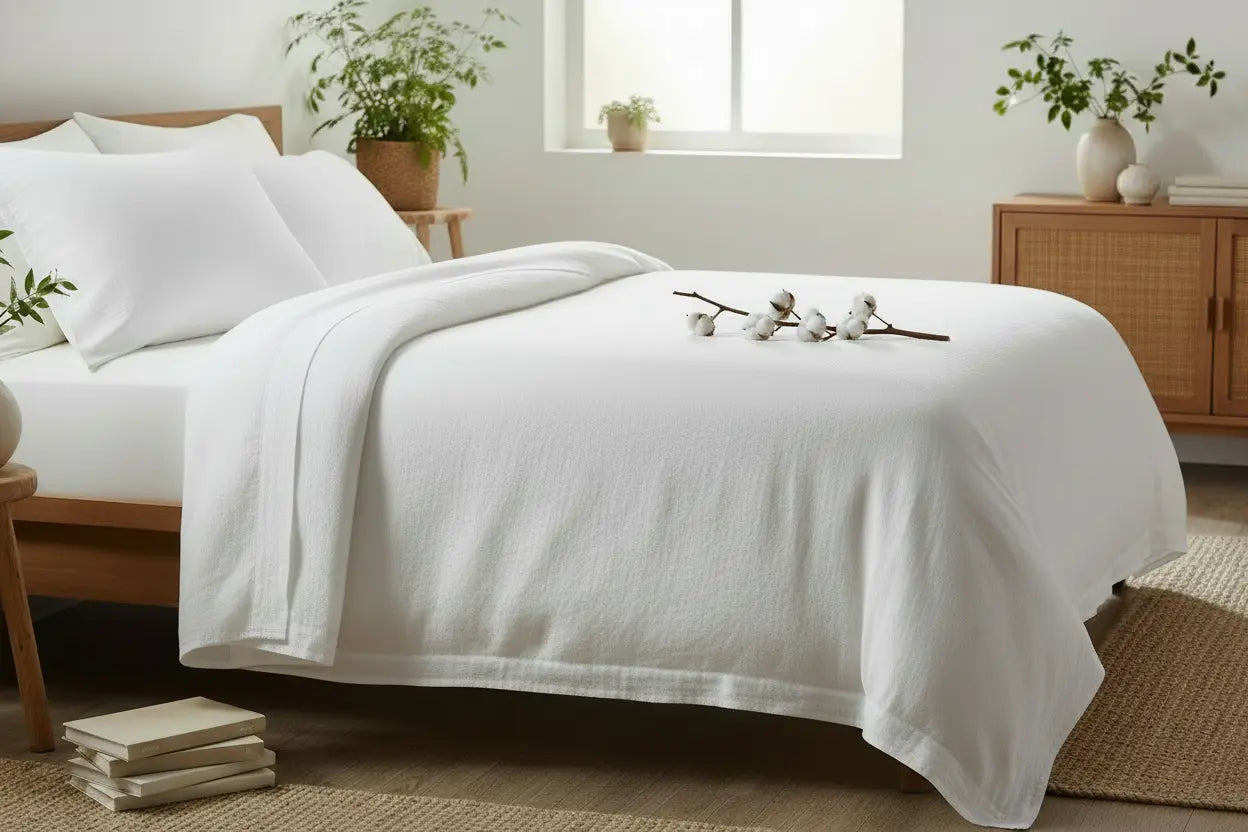
Yes - organic cotton sheets are worth it for most people who care about what touches their skin and how their bedding is made. These sheets are grown without synthetic pesticides or genetically modified seeds and finished without the harsh chemical treatments standard in conventional textile production. If you're still weighing your cotton options, the Best Cotton Sheets guide is a useful starting point.
The supply chain behind the fabric is where the difference lives. That chain matters when you're sleeping on these sheets every night. This blog covers what organic cotton sheets are, how to verify the organic claim, how they compare to regular cotton, and what to look for when you buy.
Quick Answer: Are Organic Cotton Sheets Worth It?
- Organic cotton sheets are made from cotton grown without synthetic pesticides, herbicides, or GMO seeds.
- The only reliable way to verify the claim is third-party certification - GOTS is the standard that covers the full chain.
- In feel and durability, certified organic bedding performs comparably to regular cotton at the same thread count and weave.
- The value is in what's absent: synthetic agricultural residues, undisclosed chemical finishes, unverified processing.
- Price is generally higher than conventional cotton - but the certification represents an audited, traceable standard.
For a full breakdown of what makes 100% natural cotton worth choosing in the first place, The Benefits of Cotton Sheets covers the material fundamentals.

What Is Organic Cotton Sheets - and How They're Made
To understand what organic cotton sheets are, start with the fiber. This crop is grown using methods that eliminate synthetic fertilizers, pesticides, and genetically modified seeds. Farmers rely on crop rotation, natural pest management, and soil-building practices instead. The fiber arrives at the spinning stage without a residue load from chemical agricultural inputs.
Conventional cotton is one of the most chemically intensive crops grown globally. Those chemicals don't disappear during processing - residues can carry through into the finished fabric. For people with easily irritated skin, the difference between a certified organic sheet and a conventionally processed one is a practical concern, not just an abstract one.
Organic cotton sheets also go through a restricted finishing process. Conventional bedding is often treated with formaldehyde-based wrinkle-resistance agents, optical brighteners, and silicone-based softeners. GOTS-certified organic cotton bedding restricts or bans these treatments entirely. What reaches your bed is a cleaner fabric from field to finish.
How Organic Cotton Is Grown vs Conventional Cotton
The farming differences are where the organic distinction begins:
- Conventional farming relies on synthetic pesticides and fertilizers that degrade soil health and leave residue on the harvested fiber.
- Organic farming uses natural inputs and land management practices that build soil quality rather than deplete it.
- Organic farms prohibit genetically modified seeds, which are standard in most large-scale conventional operations.
- Certified organic farms undergo regular independent audits - self-declared "natural" is not the same thing.
Organic cotton fiber is not structurally different from conventional cotton under a microscope. The difference is entirely in what was - and wasn't - applied during growth and processing. That is what this bedding is: cotton held to a verified standard at every stage of production.
What Organic Cotton Sheets Are Made Of
Organic cotton sheets are made from 100% natural plant fiber - no synthetic materials, no plastic-based components. They come in percale and sateen weaves, different thread counts, and different weights. If the product carries a legitimate certification like GOTS, every step of the production process has been independently verified.
A 300 thread count organic cotton percale sheet has a crisp, clean texture with a matte finish. It feels light on the skin and gets noticeably softer with every wash. Thread count in organic cotton works exactly the same as in any cotton - it describes the density of the weave and tells you how the sheet will feel. Different thread counts offer different sleep experiences. Choose based on how you like your sheets to feel - not just the highest number. The Classic Percale Organic Cotton is a good example of what a well-made 300TC organic cotton percale looks and feels like in practice - GOTS certified, clean finish, and built to soften with every wash.
How Do I Know If a Product Is Really Organic Cotton?
This is one of the most important questions to ask when buying organic cotton sheets, because "organic" carries no legal weight in textile labeling in most markets. A product can be sold as "made with organic cotton" while containing a fraction of organic fiber - or using organic fiber but processing it with conventional chemical treatments that defeat the point.
The only reliable way to confirm the organic claim is truly verified is third-party certification. The two most relevant:
- GOTS (Global Organic Textile Standard) - the most comprehensive certification, covering fiber, processing, and labor practices across the full supply chain
- OEKO-TEX Standard 100 - tests the finished product for harmful substances, but does not certify the farming or processing chain the way GOTS does
These certifications are issued by accredited bodies after on-site audits and independent lab testing. They are not self-declared and are not permanent - brands must reapply and re-verify regularly.
What to Look for on the Label When Buying Organic Cotton Sheets
When shopping for this type of certified bedding, check for:
- A GOTS certification mark with a license number verifiable at global-standard.org
- The certifying body's name - not just "GOTS" printed on the package without credentials
- A percentage statement: "100% organic cotton" vs "made with organic cotton" (the latter can legally mean as little as 5% organic fiber)
- OEKO-TEX Standard 100 as a secondary signal the finished fabric has been tested for harmful substance limits
What to be skeptical of:
- "Eco-friendly" or "natural" claims with no third-party certification attached
- "Organic blend" with no percentage disclosed
- Certifications that cannot be verified online
If a brand cannot point you to a traceable certification number, that matters. Legitimate certifications are publicly searchable.
What Is the Global Organic Textile Standard?
The Global Organic Textile Standard - GOTS - is the leading certification for this category of bedding and other organic textiles worldwide. It was developed by four international organizations and covers every stage of the supply chain, from raw fiber to finished product.
GOTS has two tiers:
- "Organic" label: requires 95% or more certified organic natural fibers
- "Made with organic" label: requires 70% or more certified organic natural fibers
For a product to carry the GOTS label, every stage of production - fiber sourcing, spinning, weaving, dyeing, finishing, and packaging - must comply with strict environmental and social criteria. That includes restrictions on permitted dyes and chemicals, wastewater treatment requirements, and labor standards across the chain.
Why GOTS Certification Makes Organic Cotton Sheets Worth It
GOTS certification is what separates a verified organic cotton sheet from a marketing claim. Without certification, there is no verified standard being met. With it, you know the cotton fiber was grown to audited organic standards, the processing used restricted inputs, and an independent body - not the brand - confirmed it at every stage.
OEKO-TEX Standard 100 adds another layer - testing the finished fabric for over 100 harmful substances, including pesticide residues, heavy metals, and formaldehyde. A set carrying both GOTS and OEKO-TEX has been verified at multiple independent points. That's what separates a certified organic cotton sheet from a marketing claim.

Are Organic Cotton Sheets Worth It? Breaking Down the Value
"Worth it" means different things depending on what you're comparing.
Against synthetic sheets, the case is direct. Organic cotton is a 100% natural fiber. It contains no plastic-based components and sheds no microplastics into the wash. Synthetic bedding does. Over hundreds of wash cycles, that's a meaningful difference - environmentally and in terms of what you're sleeping on.
Against regular cotton, the comparison is more nuanced. The fiber performs comparably at the same thread count and weave. The distinction lies in the production chain - and in what isn't present in the finished fabric.
Organic Cotton Sheets vs Regular Cotton: What Actually Changes?
Here's a clear side-by-side of what organic cotton sheets vs regular cotton offer:
|
Feature |
Organic Cotton Sheets |
Regular Cotton Sheets |
|
Fiber type |
100% natural cotton - certified organic |
100% natural cotton - conventionally grown |
|
Farming inputs |
No synthetic pesticides, no GMO seeds |
Synthetic pesticides and fertilizers standard |
|
Chemical treatment |
Restricted by GOTS or equivalent |
Standard processing, may include chemical finishes |
|
Certification |
GOTS, OEKO-TEX (verified chain) |
OEKO-TEX optional; no farming-level standard |
|
Feel and softness |
Comparable at the same TC and weave |
Comparable at the same TC and weave |
|
Durability |
Strong - equivalent to conventional |
Strong |
|
Environmental impact |
Lower farming chemical load |
Higher farming chemical load |
|
Price |
Generally higher |
Generally lower |
|
Gets softer with washing |
Yes |
Yes |
Organic cotton sheets are not automatically softer or more durable than conventional sheets at the same thread count and weave. Where organic cotton sheets are worth it is in what you're not getting - residual chemical treatments, unverified processing, and an unaudited supply chain. For people with easily irritated skin, or those who want to know exactly what went into their bedding, that distinction is meaningful.
Are Organic Cotton Sheets Soft?
Yes. Organic cotton sheets are soft - and they get softer with every wash. The softness of any cotton sheet is determined primarily by weave and thread count. Organic certification doesn't change those variables. An organic cotton percale at 300TC feels the same as a conventional percale at 300TC: crisp and matte-textured when new, then increasingly soft and broken-in over time.
What this certified bedding doesn't carry is the artificial softness from silicone-based chemical softeners sometimes applied to conventional sheets during finishing. That synthetic softness fades after a few washes. The natural softness builds gradually as the fiber relaxes and opens up through regular laundering - and it keeps improving.
How Weave Affects Softness in Organic Cotton Sheets
The weave structure is the most direct factor in how a sheet feels:
- Percale weave: a one-over, one-under interlocking structure that creates a crisp, matte texture. Sheets feel lighter and more structured, sharper when you first get into bed, and noticeably softer over time.
- Sateen weave: a four-over, one-under structure that produces a smoother, lightly sheen surface. Sateen sheets in organic cotton feel more fluid and close to the skin from the first use.
Neither is objectively better - it depends on preference. Percale suits those who like a clean, cool texture. Sateen suits those who prefer something that feels silkier from the start. Thread count shapes the experience further: at 300TC, percale sheets have an open, airy hand; higher counts feel denser and more substantial.
Are Organic Cotton Sheets Durable?
Organic cotton sheets are durable. Well-made organic cotton bedding holds up for years when cared for correctly. Cotton is a naturally strong fiber, and percale and sateen weave structures add dimensional stability. The certification process doesn't compromise durability - it governs what goes into the fabric, not the structural integrity of the weave.
Durability is more directly influenced by thread count, weave construction, and care habits than by whether the cotton is organic or conventional. A well-made set at a solid thread count, washed in cool water and dried on low heat, will hold up longer than a carelessly treated set of any kind.
How to Care for Organic Cotton Sheets to Make Them Last
- Wash in cool or warm water - not hot. High heat breaks down cotton fibers over time.
- Use a gentle, phosphate-free detergent. Avoid bleach.
- Tumble dry on low heat or line dry. Over-drying is one of the fastest ways to weaken the fabric.
- Skip fabric softeners - they coat the fiber and reduce the natural breathability of the cotton over time.
- Rotate between two sets so each goes through fewer wash cycles per month.
If you want a set built to last through consistent care, the Classic Percale Organic Cotton is a well-made option - 100% natural cotton, GOTS certified, and woven to hold up well when laundered correctly.
Why California Design Den Organic Cotton Sheets Are Worth It
If you're asking whether organic cotton sheets are worth it, the answer depends a great deal on the brand behind the claim. California Design Den sheets are made for people who want to sleep on something clean, comfortable, and verified - not just labeled. California Design Den sheets are made from 100% natural cotton — no synthetic microfiber, no plastic fibers. The sets are GOTS certified, meaning the certification covers the full production chain: fiber sourcing, spinning, weaving, finishing, and packaging. The organic cotton sheet sets - percale and sateen - have earned the Good Housekeeping Seal.
What makes these organic cotton sheets worth it:
- 100% natural cotton fiber - no blended synthetics, no plastic-based components, no microplastics released in the wash
- GOTS certified organic cotton - independently audited, not self-declared
- OEKO-TEX Standard 100 tested for over 100 harmful substances in the finished fabric
- Most of our cotton sheets are made in our family-owned facility – production oversight that matters
- Backed by the Good Housekeeping Seal with a 2-year limited warranty
- Trusted by 8 million+ sleepers with a 4.5–4.6 star average
The 300TC percale is a strong starting point for anyone asking whether organic cotton sheets are worth it. It's not artificially softened. It improves with every wash. The price reflects a verified supply chain - not a premium for using the word "organic" without backing it up.
How to Choose Organic Cotton Sheets: A Buying Guide
Knowing that organic cotton sheets are worth it is step one. Choosing the right set is step two. Here's what to look at:
- Certification first: Look for GOTS with a verifiable license number. OEKO-TEX Standard 100 on the finished fabric is a solid secondary check. No certification number - no verified claim.
- Weave: Percale for a crisp, structured, lightweight feel. Sateen for a smoother, softer feel from the first wash.
- Thread count: Different thread counts offer different sleep experiences. 300TC feels light and airy - higher counts feel denser and more substantial. Choose based on how you like your sheets to feel - not just the highest number.
- Fiber percentage: "100% organic cotton" is different from "made with organic cotton." Read the label.
- Brand track record: Look for reviews, press coverage, or third-party recognition beyond self-declared claims.
- CDD's organic cotton percale is available at 300TC. Prefer something with more weight and body? The cotton collection goes up to 1000TC - each step offers a different feel, from smooth and balanced at 400TC to rich and substantial at 1000TC. Choose based on how you like your sheets to feel.
Are Organic Cotton Sheets Worth It - The Final Verdict
Organic cotton sheets are worth it when they carry legitimate certification - GOTS in particular - and are made from 100% natural cotton without synthetic fibers or undisclosed chemical finishes. The value isn't a dramatically different texture or superior softness out of the box. The value is in a verified, traceable product that holds to a confirmed standard from field to finished fabric.
Compared to regular cotton, this bedding offers a cleaner, audited production chain. Compared to synthetic bedding, they're a natural fiber with no plastic components and no microplastics released in the wash. At 300TC percale, this certified bedding feels crisp and breathable - and gets noticeably softer with every wash.
If you want bedding you can verify rather than simply take at its word, organic cotton sheets - backed by GOTS certification and OEKO-TEX testing - are a well-founded choice. The Classic Percale Organic Cotton Sheet Set - available in Olive Green and Navy Blue - is GOTS certified and built to soften with every wash. The certification exists because "organic" without it means very little. With it, it means something specific, audited, and real.

Frequently Asked Questions About Organic Cotton Sheets
Are organic cotton sheets worth it for people with sensitive skin?
Yes. GOTS-certified organic cotton sheets are made without synthetic residues or chemical finishes. 100% natural cotton - gentle on easily irritated skin, wash after wash.
Are organic cotton sheets worth it compared to regular cotton?
Yes - when GOTS certified. Organic cotton sheets offer the same feel and durability as regular cotton, with a fully audited, chemical-restricted supply chain behind every set.
Should you avoid drying 100% organic cotton sheets in high heat?
Yes. Dry organic cotton sheets on low heat or line dry. High heat weakens natural cotton fibers and causes shrinkage. Low heat preserves the weave and fit wash after wash.
Why are people switching to organic cotton sheets from regular cotton?
GOTS-certified organic cotton sheets mean a verified supply chain - no synthetic residues, no undisclosed chemical finishes, no microplastics released in the wash.
How much will 100% organic cotton sheets shrink after washing?
Organic cotton sheets shrink 3–5% in the first wash. Wash in cool water and tumble dry on low heat to minimize shrinkage and keep your fitted sheet fitting correctly.


