

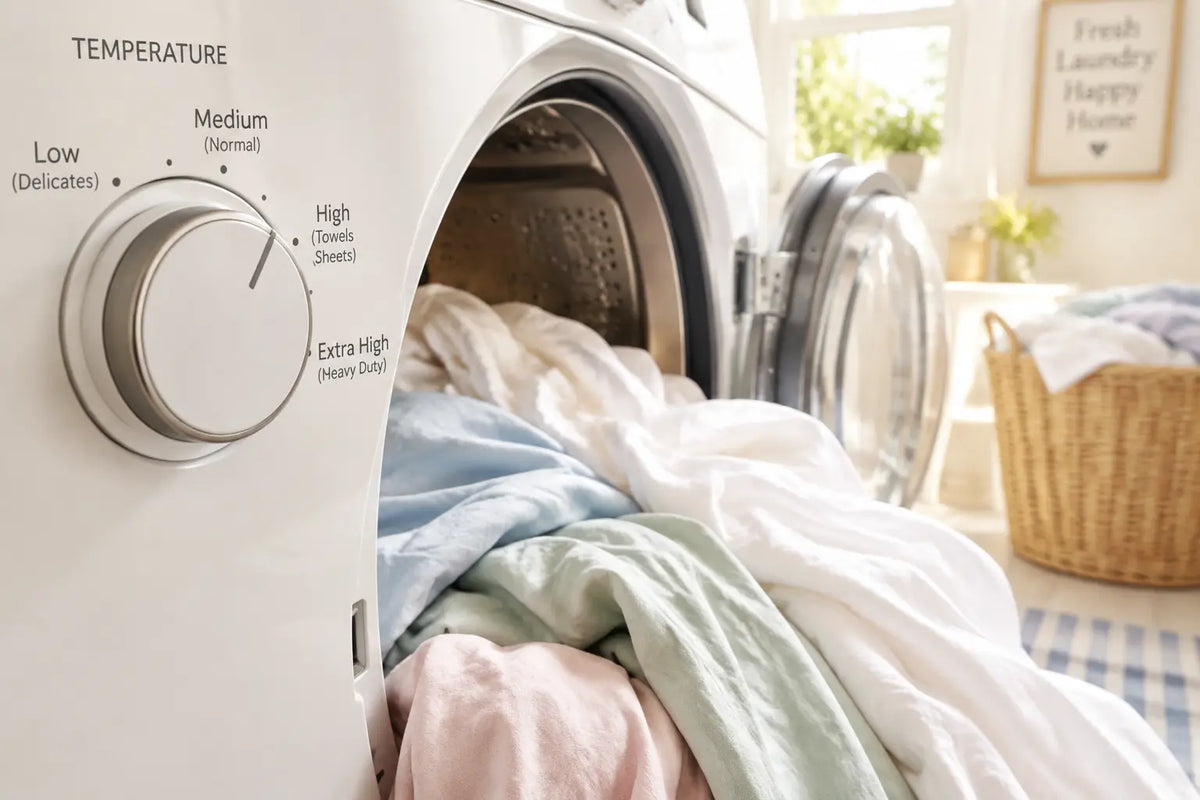
What dryer setting for sheets works best for every fabric
What dryer setting for sheets should you use? Low heat is right for most cotton sheets, including the California Design Den Sheet sets covered in this guide. Low heat dries cotton evenly, and taking sheets out promptly helps reduce wrinkles. The care label on your exact set is the final word, so check it before you press start.
Getting the setting right isn't only about softness. The setting also affects how long a drying cycle takes, and whether you end up running the dryer twice because the load came out damp. Answering what dryer setting for sheets works best from the start saves both the fabric and the extra electricity.
California Design Den is a family-owned cotton bedding brand, and the care lines in this guide come from the care labels on our own sheet sets. Below, you'll find the exact setting to use, how to prep and load a full-size sheet set, how to judge cycle length by fabric weight, and the mistakes that quietly wear sheets out faster than normal use ever would. Once you've read the fabric-specific notes here, choosing what dryer setting for sheets fits your own linen closet becomes a quick, repeatable decision rather than a guess.
Quick answer: what dryer setting for sheets works best
The short version, before the full explanation: run cotton sheets on low heat, remove them promptly when the cycle ends, and check the care label any time a set uses a fiber blend you haven't dried before.

What dryer setting for sheets suits your fabric
- Natural Organic Cotton Percale Sheet Set: machine wash warm, tumble dry low, do not bleach.
- Premium Portuguese Cotton Flannel Sheet Set: machine wash warm, tumble dry low, remove promptly to help reduce wrinkles.
- Sheets from another brand: follow the heat setting on that set's care label.
- Unsure? Start with low heat and a shorter cycle, and check the load before adding time.
Why drying time depends on the fabric
A heavier weave and a lighter weave don't dry at the same rate, and they don't tolerate the same heat. Weight, weave, and finish all play a role, which is why the label on your exact set matters more than a single blanket rule. Two people can own sheets from the same price range and still need a different answer to what dryer setting for sheets suits their specific set, simply because the fabrics are different.
A quick way to think about it: the tighter and lighter the weave, the more likely low heat is correct, since there's less fabric holding water and less risk of overheating a thin weave. The thicker and more textured the weave, the more likely the label calls out a specific setting worth following exactly, rather than defaulting to whatever the dryer remembers from the last load. Heavier weaves like flannel take longer to dry than a lighter weave like percale, even though each is labeled for its own correct setting. The label on your exact set tells you the heat, and the weave tells you roughly how long to expect.
|
Fabric or program |
Recommended dryer setting |
Care note |
|
Natural Organic Cotton Percale Sheet Set, Navy Blue |
Low heat |
Machine wash warm, tumble dry low, do not bleach |
|
Premium Portuguese Cotton Flannel Sheet Set, Woodland Motif |
Low heat |
Machine wash warm, tumble dry low, remove promptly to help reduce wrinkles |
Preparing your sheets before you choose a dryer setting
A few minutes of prep does more for the outcome than any setting on the dial. Sheets that go into the dryer twisted, overloaded, or mixed with the wrong fabrics come out uneven no matter what heat you choose. If the wash cycle itself is the part you're less sure about, our guide on how to wash bed sheets covers water temperature and detergent amounts in more depth than we'll repeat here.
Separate sheets by weight and fabric first
Wash and dry a flat sheet, fitted sheet, and pillowcases from the same set together, and keep heavier fabrics like flannel separate from lighter percale or sateen. Mixing a heavy flannel set with a light percale set means one finishes drying long before the other, and the lighter fabric sits exposed to heat it doesn't need.
Shake out sheets and check the load size
Shake each piece out before it goes in the dryer so the fabric isn't balled up or twisted. A twisted fitted sheet dries unevenly, with damp pockets in the folds long after the rest of the load reads dry. One queen or king sheet set is usually enough for a single load - a stuffed drum blocks airflow and forces you to run a second cycle to finish the job.
A short prep checklist before you touch the dial:
- Turn pillowcases right-side out and shake them open
- Unroll the fitted sheet's corners so the elastic isn't folded on itself
- Sort by fabric weight, not just by color, before you load the drum
- Confirm the care label's heat setting matches what you're about to select
That last step decides which heat setting you should be running that day.

Loading, timing and air-drying your sheets
Once the setting is chosen, how you load the dryer and how long you run it make the rest of the difference.
How to load sheets into the dryer correctly
Load sheets loosely rather than packed tight, and add a bath towel or two if the load feels light - the extra fabric helps tumble the sheets instead of letting them clump into one mass. Close any buttons or ties on a duvet cover before it goes in, since an open closure can catch on the fitted sheet's elastic during the tumble.
Timing your dryer settings for sheets by fabric weight
Lighter weaves like percale and sateen generally dry faster than a heavier flannel set, though the exact heat setting still depends on that fabric's label rather than the weight alone. Cotton flannel, being a heavier weave, usually needs a longer cycle simply because there's more fabric to dry through. Check the load partway through if it's your first time drying a new set, so you get a feel for that set's actual cycle time before you plan the rest of laundry day around it.
Dryer balls and other tools that help
Wool or rubber dryer balls help separate the layers of a folded sheet as it tumbles, which can shorten the cycle slightly and reduce the twisted, rope-like look sheets sometimes come out with. Avoid dryer sheets directly against a flannel or percale finish if the label warns against fabric softener residue, since buildup over time can dull a crisp or plush finish.
Most dryer dials use three heat terms:
- Low heat: gentle enough for daily cotton loads, and the setting on both featured sets' care labels
- Medium heat: a step warmer, for fabrics whose care label calls for it
- High heat: best kept for items whose care label calls for it, not bed linens
Knowing what each setting actually means makes the label easier to follow instead of guessing at it. A dryer's dial doesn't always use the words "low," "medium," and "high" directly - some list temperatures or fabric types instead - so it helps to check your machine's manual once and note which position matches which setting.
A dryer isn't the only option, and air-drying is worth knowing for fabrics that benefit from a gentler finish. It also comes in handy on a day when the dryer is already running a full load of towels or bedding and a single sheet set needs to dry sooner than the queue allows, or when you'd simply rather skip the extra electricity a dryer cycle uses.
Air-drying sheets on a line or rack
Hang sheets on a clothesline or a drying rack in a well-ventilated space, out of direct, intense sun if you want to protect color over time. Smooth the fabric out by hand before hanging so it dries with fewer wrinkles and needs less ironing or steaming afterward.
When air-drying works better than a dryer setting
Air-drying is a reasonable choice any time you want to skip heat altogether, or when you're short on dryer time and can let sheets dry overnight instead. It won't produce the same soft, tumbled hand that a dryer with dryer balls gives you, so it tends to suit lighter weaves like percale better than heavier flannel.
A lighter percale weave usually air-dries sooner than a heavier flannel weave, which can take considerably longer on a line simply because there's more fabric holding water. If you're deciding between the two methods on laundry day, that time difference is often the deciding factor rather than what dryer setting for sheets you'd otherwise choose.

Common mistakes with dryer settings for sheets
Most sheet damage doesn't come from one bad wash. It comes from small habits repeated over months, and each one is easy to fix once you notice it.
Running everything on high heat out of habit
High heat dries a load faster, but it's also the fastest way to weaken cotton fibers and fade color over time. If a label lists low or medium heat, that setting was chosen for a reason specific to that fabric's weave and finish.
Leaving sheets in the dryer after the cycle ends
Sheets left sitting in a warm drum after the cycle finishes tend to wrinkle as the fabric cools unevenly. The fix is simple: remove them promptly once the cycle is done, which is the single easiest habit for a smoother, less-creased fold straight out of the dryer.
Overloading the dryer to save time
Cramming a full sheet set plus a comforter into one load might feel efficient, but a packed drum blocks airflow. The fabric on the outside of the load dries first while the center stays damp, and running a second cycle on already-tumbled sheets adds unnecessary heat exposure.
Using too much fabric softener or dryer sheets
A heavy dose of fabric softener can leave a coating on cotton fibers over time, which dulls a crisp percale finish and mutes the plush hand of a flannel weave. If a set's label doesn't call for softener, skip it and let the wash cycle and the correct dryer setting do the work instead. A well-chosen heat setting, paired with a full but not overstuffed load, tends to do more for softness over time than any additive poured in at the wash step.
California Design Den sheets and the right dryer setting
The right setting isn't only a laundry question. It's part of caring for a sheet set the way its label intends.
Premium Portuguese Cotton Flannel Sheet Set care and dryer setting
A flannel set earns its warm, plush feel from being triple-brushed, and that same construction is why the dryer setting matters here. The Premium Portuguese Cotton Flannel Sheet Set in woodland motifs is crafted from 100% cotton flannel, brushed three times for its signature softness, with a velvety plush hand.
The Premium Portuguese Cotton Flannel Sheet Set is 100% cotton, with no petroleum-based synthetic fibers, no polyester and no microfiber. It's tested for harmful substances to OEKO-TEX STANDARD 100. Backed by the Good Housekeeping Seal. The care instructions are specific for a reason: machine wash warm, tumble dry low, remove promptly to help reduce wrinkles. This flannel is crafted in Portugal, a centuries-long tradition of European textile craftsmanship.
The look is fuzzy, plush and cozy, and the feel is heavy, thick and warm without bulk. This is a warm, heavyweight cotton flannel, best suited to cold sleepers and cold-weather bedrooms. Following the low-heat setting on the label is the simplest way to care for that plush hand.
If you're setting up a bedroom for cold-weather comfort, the Premium Portuguese Cotton Flannel Sheet Set in woodland motifs is built for exactly that kind of night.
Natural Organic Cotton Percale Sheet Set care and dryer setting
Percale is a one-over-one-under weave, matte and open, which is what gives it a crisp, airy feel. The Natural Organic Cotton Percale Sheet Set in navy blue is woven from 100% certified organic cotton in a percale weave, with a lightweight, airy hand that stays breathable and never feels thick.
The Natural Organic Cotton Percale Sheet Set is a Global Organic Textile Standard (GOTS) Certified Organic Cotton Percale Sheet Set. The fabric is 100% cotton, with no petroleum-based synthetic fibers, no polyester and no microfiber. Backed by the Good Housekeeping Seal. Its care line: machine wash warm, tumble dry low, do not bleach. Following that label from the first wash keeps the care routine simple.
The look is crisp with a clean matte finish, and the feel is lightweight and airy - not thick - with a hand that stays close to a freshly pressed dress shirt. The low-heat setting on its label matches the flannel set, which keeps laundry day simple for households that own both.
The Natural Organic Cotton Percale Sheet Set in navy blue shows that a crisp, lightweight weave and a heavy flannel can share the same heat setting while needing different drying times. Anyone building a bedroom around organic fibers can browse the wider Organic Cotton Sheets range on the site for more options in the same weave family. Most of our cotton sheets are made in our family-owned facility.

How to choose the right dryer setting for sheets
If you own more than one type of sheet set, a quick decision process makes it easy to match each fabric to its label without you having to memorize every label by heart.
Match the setting to the fabric, not the fastest cycle
Start with low heat as your default for any cotton sateen, percale or flannel set, and confirm it against the care label on each set before its first dry. Reserve a medium setting for a fabric from another brand whose label specifically calls for it, rather than assuming every weave dries the same way.
If your household owns a mix of fabrics, keep a short written note by the laundry room listing the correct heat setting for each set in that specific rotation, so nobody has to guess or rely on memory between wash days. A quick label check the first time you dry a new set is a small habit that pays off every wash after, and it means anyone doing laundry in the house - not just the person who bought the sheets - can get the setting right on the first try. That single habit is more reliable than any dryer ball, fabric softener, or trick learned secondhand.
When to read the care label instead of guessing
A care label is written for that exact fabric and finish, so it should always outrank a general rule of thumb. If you're mixing sheets from different collections in the same laundry day, wash and dry each set separately so one label's instructions never get applied to the wrong fabric. When you're shopping for something new, browsing the full sheet set range alongside each product's care label makes it easy to know the right setting before the order even arrives.
If organic fibers are the priority for your household, check the care label on each set in the organic cotton range before its first wash, the same way you would for the navy blue percale set above. Keeping one simple habit of reading the label, rather than relying on memory for each individual sheet, is the easiest way to avoid a mix-up on laundry day.
The short answers below cover common follow-up questions for readers who already know the general rule but want a fast confirmation for a specific situation.
Frequently asked questions about dryer settings for sheets
Should I dry my sheets on low or high heat?
Low heat is correct for most cotton sheets. High heat dries faster but wears down fibers and fades color sooner, so it isn't worth the time saved.
Is it okay to dry sheets in the dryer?
Yes, tumble drying is fine for cotton sheets as long as the heat setting matches the fabric's label, and you remove the load promptly once it finishes.
How do I stop sheets from wrinkling in the dryer?
Use the heat on the care label, keep the load loose, and take sheets out promptly when the cycle ends so the fabric doesn't cool in folds.
Which dryer setting is best for bedding?
Low heat suits most cotton bedding, including percale, sateen and flannel. If your set's care label lists a different setting, follow the label.
What settings should I use for bed sheets?
Tumble dry on the heat listed on the care label. For most cotton sheet sets, that means low heat, a loose load and prompt removal.
Final verdict
Low heat and prompt removal
For most cotton sheets, low heat and prompt removal are the two habits that matter most. Read the label once when a new set arrives, and repeat that same setting every time it goes through the dryer.
Let the care label decide
The care label on your exact set is the final word. At California Design Den, the care line for the Natural Organic Cotton Percale Sheet Set is machine wash warm, tumble dry low, do not bleach, and the care line for the Premium Portuguese Cotton Flannel Sheet Set is machine wash warm, tumble dry low, remove promptly to help reduce wrinkles. Each line is written for that program alone, which is why checking the label on your own set matters more than following a single rule for every fabric in the house. For the wash side of the process, the wash guide linked earlier in this post walks through the cycle and water temperature in full.


