

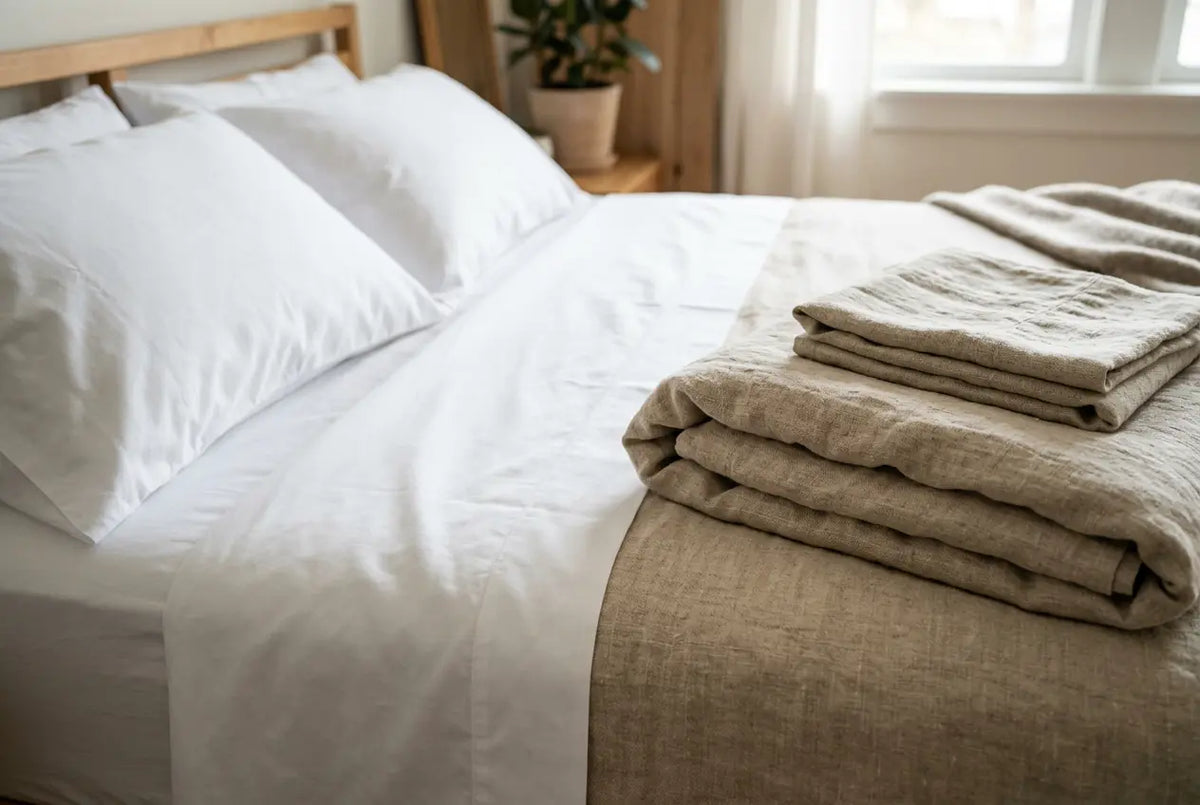
Percale vs linen: which sheet fabric suits how you sleep?
Percale vs linen comes down to the feel you want against your skin. Percale, the weave behind our Cotton Percale Sheets, is cotton woven one-over-one-under, so it feels crisp, matte and lightweight. Linen is woven from flax, so it feels textured, relaxed and heavier in the hand. In the percale vs linen decision, choose percale for a tailored, airy bed and linen for a lived-in look.
At California Design Den, we make cotton sheets, including two percale sets, so we pay close attention to how a weave feels on the bed. Both fabrics are natural fibers. Percale has a matte surface, while linen has a soft, natural luster.
Where they part ways is texture, weight, wrinkles and care. Below, we compare percale and linen on each of those points, match each fabric to a sleep style, and show where our two percale sets fit.
Quick answer: percale vs linen in brief
Percale is the crisp, matte, lightweight choice. Linen is the textured, relaxed, heavier choice. Neither fabric is a step up from the other. Each one suits a different sleeper.
If you only remember one thing, remember this: percale is about crispness and lightness, and linen is about texture and weight. Everything else, from wrinkles to care, follows from those two traits.
Choose percale over linen if you like a crisp, tailored bed
Percale suits sleepers who want the bed to feel fresh and neat the moment they slide in. Pick percale if these sound like you:
- You like the feel of a freshly pressed cotton shirt.
- You want a lightweight sheet that is not thick.
- You prefer a smooth, matte surface with clean lines.
- You like a clean, matte look on a made bed.
Choose linen over percale if you like a relaxed, textured bed
Linen suits sleepers who like character in their bedding. Pick linen if these sound like you:
- You enjoy a nubby, slubbed texture under your hand.
- You like a rumpled, lived-in look on the bed.
- You want more weight and a fluid drape.
- You are happy to skip the iron and let creases stay.

Percale vs linen sheets side by side
This table compares the two fabrics on fit, not on score. Use it to spot which column reads like the bed you picture.
|
Attribute |
Percale |
Linen |
|
Fiber |
Cotton |
Flax |
|
Weave |
One-over-one-under, tight and even |
Usually plain weave, with natural slubs in the yarn |
|
Feel |
Crisp, smooth and airy |
Textured and relaxed, softening with washing |
|
Look |
Matte and tailored |
Soft natural luster, rumpled and lived-in |
|
Weight |
Lightweight and not thick |
Heavier, with a more substantial hand |
|
Wrinkles |
Fold or smooth promptly after drying |
Wrinkles readily, and that is part of the look |
|
Season |
Year-round, and layers easily under a duvet |
Warm months and layered beds |
|
Who it suits |
Sleepers who want a crisp, fresh bed |
Sleepers who want a casual, textured bed |
Understanding the fundamentals of percale vs linen
Percale is a weave, and linen is a fiber. That one fact explains most of the differences you will feel on the bed.
Percale describes how threads cross on the loom. Linen describes what the threads are spun from. So you can find percale woven from different cottons, and you can find linen woven in different ways.
Percale: a crisp cotton weave
Cotton percale is a fabric woven one-over-one-under. Each crosswise thread passes over one lengthwise thread and under the next. That simple grid gives percale its matte surface and open, airy hand.
The tight, even weave makes percale feel crisp and smooth rather than slick. We describe the hand as close to a freshly pressed cotton shirt.
Fiber quality shapes percale too. Extra-long staple cotton, like the Egyptian cotton in the Signature Egyptian Cotton Percale Sheet Set, spins into a smooth yarn, and that yarn gives the weave a clean, even surface. So two percale sheets can share a weave and still feel slightly different in the hand.
What is linen?
Linen is a fabric spun from the fibers of the flax plant.
Flax fibers are long and slightly irregular. So linen yarn carries small natural irregularities called slubs. Those slubs give linen its textured look and nubby hand.
Linen sheets are often woven in a plain weave too. The yarn, not the weave, is what makes linen feel so different from cotton.
That is also why linen looks the way it does. The uneven yarn catches light softly, so a linen sheet has a gentle, heathered look even in a solid color.
How fiber and weave shape percale and linen
Four things decide how any sheet feels. Here is how each one plays out for these two fabrics:
- Fiber sets the base feel. Cotton has a smooth hand, while flax starts out firmer and more textured.
- Weave sets the surface. The percale weave is a tight one-over-one-under grid, which reads crisp and matte. A sateen weave, by contrast, floats four threads over one for a smoother face with more sheen.
- Yarn sets the weight. Linen sheets usually carry more weight on the bed than percale.
- Finishing sets the first touch. How a fabric is finished after weaving shapes how it feels on the first night.

Percale vs linen benefits, feel and texture
Percale brings a crisp, airy, tailored feel. Linen brings texture, weight and a relaxed drape. Both are natural fibers, so the choice is about character rather than quality.
Think of it this way. Percale is the sheet you choose when you want the bed to look made. Linen is the sheet you choose when you want the bed to look lived in.
Percale sheets benefits and key qualities
Percale's appeal is how fresh it feels the moment you get into bed. The tight weave and matte face give a clean, tailored look that suits a neatly made bed.
Key qualities of percale:
- Crisp hand. The surface is smooth and matte, never slippery.
- Breathable cotton. The open one-over-one-under weave lets air move through the fabric.
- Lightweight and not thick. Percale layers easily under a duvet, quilt or coverlet.
- Matte finish. With no sheen, colors read soft and even.
- Simple care. Cotton percale is machine washable.
Linen sheets benefits: why linen stays a timeless favorite
Linen has been woven for centuries, and its appeal is character. Every slub and soft crease gives the bed a relaxed, collected look.
Linen also changes with you. The fabric starts out with a firmer, drier touch and grows more fluid over the first several washes.
- Textured hand that softens with washing.
- Substantial weight and a fluid, heavy drape.
- A relaxed look that does not need ironing to look intentional.
- A soft, natural luster that suits relaxed, layered bedrooms.
Percale vs linen feel and texture comparison
Run a hand across percale and you feel a smooth, even, crisp surface. Run a hand across linen and you feel gentle ridges and slubs, with a firmer first touch that relaxes over time.
Weight is the next difference. Percale is lightweight and airy, not thick, so it sits close and light on the body. Linen has more heft, so it drapes over you and settles into folds.
- Percale: crisp, smooth, light and close-fitting.
- Linen: textured, weighty, fluid and relaxed.
- Percale: a clean, matte look on a made bed.
- Linen: falls into soft, irregular folds.
Percale vs linen care: easy care and a tailored look
Cotton percale is machine washable, and linen care depends on the care label. For percale, fold or smooth the sheets as they come out of the dryer. Linen is happiest left a little rumpled.
Care characteristics of percale
Cotton percale is simple to look after. Pull it from the dryer promptly and fold or smooth it while warm.
For the Natural Organic Cotton Percale Sheet Set, the care line is machine wash warm, tumble dry low, do not bleach. For the Signature Egyptian Cotton Percale Sheet Set, the care line is machine wash warm, tumble dry low, do not bleach.
Care characteristics of percale:
- Skip bleach.
- Tumble dry low and remove the sheets promptly.
- Give the sheets a quick press if you like a sharper finish.
Care characteristics of linen
Follow the care label on your linen sheets, since finishes vary from set to set. Skip the iron if you like the rumpled look.
- Check the care label before the first wash.
- Treat marks early, before they set into the fibers.
- Expect the fabric to relax over the first several washes.
For spills and marks, our guide How to Get Rid of Stains on Bed Sheets walks through stain removal step by step.
Wrinkles, ironing and the finished look of percale and linen
Percale and linen both crease, because both are natural fibers. The difference is in how the creases read on the bed.
With percale, smoothing the sheets as you make the bed is part of the routine. With linen, the creases stay, and that rumpled look is part of linen's charm.
- For a crisp percale bed, fold or smooth the sheets while they are still warm from the dryer.
- For a sharper percale finish, give the flat sheet and pillowcases a quick press.
- For linen, shake the sheets out well before drying and let the texture do the rest.

Choosing percale over linen: California Design Den percale sheets
We make two percale sets, and each suits a slightly different sleeper. Both have a crisp, airy feel on the bed, and both are 100% natural cotton — no petroleum-based synthetic fibers, no polyester, no microfiber. Most of our cotton sheets are made in our family-owned facility.
Sheet Sets list the fiber, weave and size for each set, so you can check the facts before you buy.
Natural Organic Cotton Percale Sheet Set
The Natural Organic Cotton Percale Sheet Set is certified organic cotton in a percale weave that's breathable and airy. The Natural Organic Cotton Percale Sheet Set has a crisp hand and a clean matte finish, and it is lightweight and airy — not thick.
The Natural Organic Cotton Percale Sheet Set is a Global Organic Textile Standard (GOTS) Certified Organic Cotton Percale Sheet Set. Backed by the Good Housekeeping Seal.
- Sizes: twin, twin XL, full, queen, king and cal king.
- Pocket depth: the Natural Organic Cotton Percale Sheet Set has 14-inch deep pockets on twin and twin XL, and 15-inch deep pockets on full, queen, king and cal king.
- Fitted sheet: all-around elastic, with head and foot tags for quick bed making.
- Pillowcases: envelope closure.
- Care: machine wash warm, tumble dry low, do not bleach.
Choose this set if you want an organic cotton percale with an airy, crisp feel. See the Natural Organic Cotton Percale Sheet Set in white.
Signature Egyptian Cotton Percale Sheet Set
The Signature Egyptian Cotton Percale Sheet Set is 100% Egyptian cotton, percale weave, extra-long staple. The Signature Egyptian Cotton Percale Sheet Set is breathable with matte-finished crispness, and it is lightweight, with extra-long staple cotton's smooth hand — not thick.
The Signature Egyptian Cotton Percale Sheet Set is tested for harmful substances to OEKO-TEX STANDARD 100. Certified with the Gold Seal by the Cotton Egypt Association — authenticating genuine Egyptian-grown cotton through DNA testing and supply chain verification. Backed by the Good Housekeeping Seal.
- Sizes: full, queen, king and cal king.
- Pocket depth: the Signature Egyptian Cotton Percale Sheet Set has a 15-inch deep pocket on full, and 16-inch deep pockets on queen, king and cal king.
- Fitted sheet: all-around elastic, with head and foot tags for quick bed making.
- Pillowcases: envelope closure.
- Care: machine wash warm, tumble dry low, do not bleach.
Choose this set if you want the smooth hand of extra-long staple cotton in a crisp, matte percale. See the Signature Egyptian Cotton Percale Sheet Set in mineral blue.
Percale sheet sizes and pocket depths
Both sets share a crisp, matte, lightweight percale hand. Here is how to tell which one fits you:
- Choose the Natural Organic Cotton Percale Sheet Set if organic cotton matters to you.
- Choose the Signature Egyptian Cotton Percale Sheet Set if you want the smooth hand of extra-long staple Egyptian cotton.
- Either set suits sleepers who want a fresh, tailored bed.
Fitted sheet measurements are width by length, in inches. Pocket depth is the fitted sheet's side depth. The Natural Organic Cotton Percale Sheet Set also comes in twin, with a 39" W x 75" L fitted sheet and a 14-inch deep pocket. The Natural Organic Cotton Percale Sheet Set in twin XL has a 39" W x 80" L fitted sheet and a 14-inch deep pocket. The Signature Egyptian Cotton Percale Sheet Set is made in full, queen, king and cal king.
|
Size |
Natural Organic Cotton Percale fitted sheet |
Natural Organic Cotton Percale pocket |
Signature Egyptian Cotton Percale fitted sheet |
Signature Egyptian Cotton Percale pocket |
|
Full |
54" W x 75" L |
15" |
54" W x 75" L |
15" |
|
Queen |
60" W x 80" L |
15" |
60" W x 80" L |
16" |
|
King |
78" W x 80" L |
15" |
78" W x 80" L |
16" |
|
Cal King |
72" W x 84" L |
15" |
72" W x 84" L |
16" |
California Design Den bedding is trusted by 8 million+ sleepers, with 100,000+ reviews and a 4.5–4.6 star average. We make our own sheets. That's why the price makes sense.
Choosing between percale vs linen sheets for your sleep style
Start with feel, then weight, then look. Your answers to those three usually settle it.
Percale vs linen sheets across the seasons
Warm sleepers usually reach for percale for its airy, open weave and lightweight hand. People who want a relaxed, textured layer usually reach for linen.
In fall and winter, percale layers easily under a heavier duvet or blanket. Linen brings its own weight to the bed, so it can carry a bed with fewer layers on top.
Percale or linen by sleep style and bedroom look
Match the fabric to how you like your bed to feel and look:
- You tuck in tightly and like a tailored bed: percale.
- You like a slouchy, unmade look: linen.
- You want a lightweight sheet that is not thick: percale.
- You want weight and drape over you: linen.
- You want a crisp, matte guest bed: percale.
If you want a smooth hand in a lightweight sheet, the Signature Egyptian Cotton Percale Sheet Set in mineral blue pairs extra-long staple Egyptian cotton with a crisp, matte hand.
If organic cotton matters to you, the Natural Organic Cotton Percale Sheet Set in white is a GOTS Certified Organic Cotton Percale Sheet Set with a crisp, airy hand.
Questions to ask before you buy percale or linen
A few quick questions save a return later:
- Do I want a crisp hand or a textured one?
- Do I want a lightweight sheet or more weight on the bed?
- Am I happy with visible wrinkles?
- Which size do I need, and which pocket depth fits my setup?
- How will I wash and dry my sheets each week?
You also do not have to pick one fabric for every layer. Percale sheets under a linen duvet cover give you a crisp feel against the skin and a relaxed, textured look on top.
To compare percale colors and sizes in one place, browse our Cotton Percale Sheets.
Whichever fabric you pick, keep our guide How to Get Rid of Stains on Bed Sheets handy for spills.

Frequently asked questions about percale vs linen
Can I use percale sheets with a linen duvet cover?
Yes. Percale sheets under a linen duvet cover give you a crisp feel against the skin and a relaxed, textured look on top.
What to avoid when buying bed sheets?
Avoid vague fiber labels, polyester blends if you want all-cotton, and a pocket depth that does not fit. Check fiber, weave and size first, whether you choose percale or linen.
What is the difference between 100% cotton and 100% cotton percale?
100% cotton names the fiber. 100% cotton percale names the fiber and the weave, one-over-one-under, which gives a crisp, matte hand. Percale vs linen compares a weave with a fiber.
Is percale lighter than linen?
Yes. Percale is lightweight and not thick, so it sits light on the bed and layers easily. Linen sheets usually feel heavier, with a fuller drape.
How do Egyptian cotton and percale sheets differ?
Egyptian cotton names an extra-long staple fiber. Percale names a crisp one-over-one-under weave. The Signature Egyptian Cotton Percale Sheet Set brings both together in one set.
Final verdict on percale vs linen
Choose percale if you want a crisp, lightweight, tailored bed. Choose linen if you want texture, weight and a relaxed look.
Neither answer is wrong. The right sheet is the one that matches the bed you picture when you close your eyes at night.
When percale is the right fit over linen
Percale fits sleepers who love a fresh, smooth, matte bed. Percale is lightweight and airy, not thick, and it layers easily under a duvet or quilt.
When linen is the right fit over percale
Linen fits sleepers who want texture, weight and a lived-in look. If creases feel charming rather than messy, linen will feel at home on your bed.
Linen also pairs well with other textures. Wool throws, quilted coverlets and cotton percale pillowcases all sit comfortably beside it, so you can build a layered bed that still feels relaxed.
If you land on cotton, Sheet Sets from California Design Den let you compare weaves, sizes and colors side by side.


