

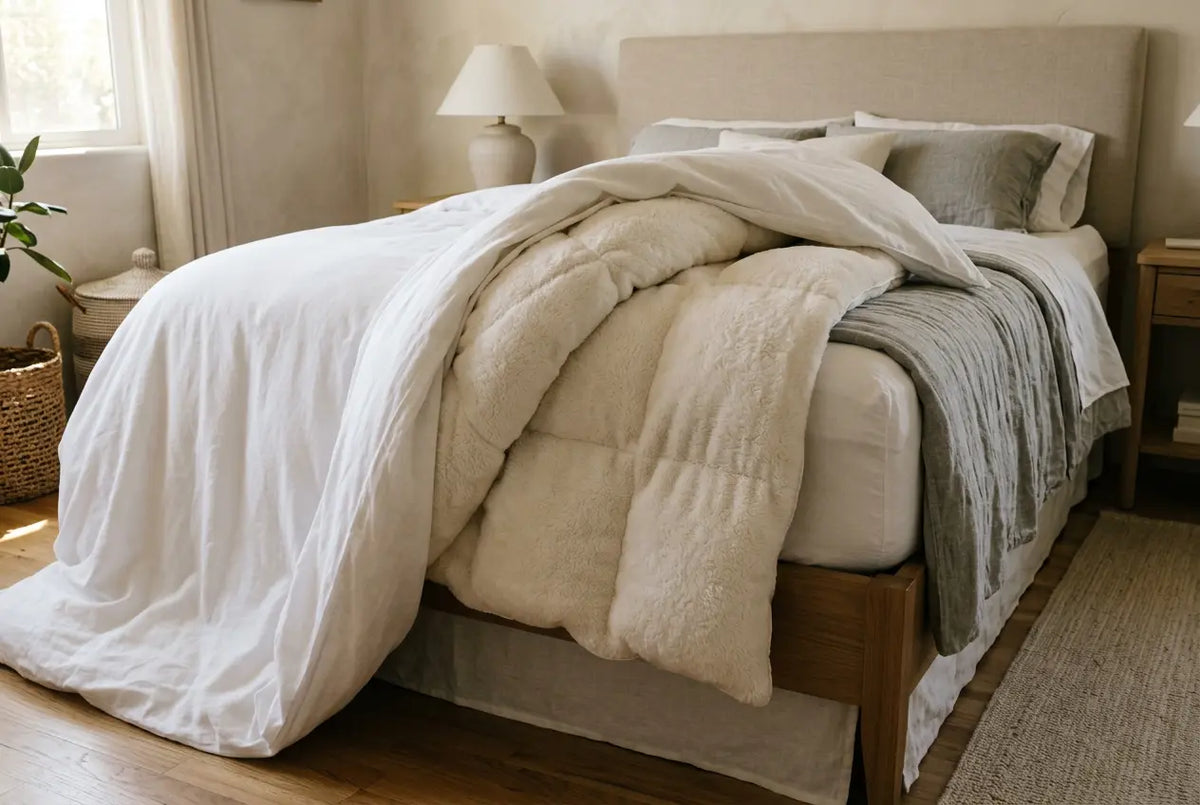
Can you put a duvet cover over a comforter? Yes, here's how
Can you put a duvet cover over a comforter? Yes. A duvet cover works as a removable case, so the comforter goes inside it, as long as the comforter's width and length are close to the cover's. For the basics of the cover itself, read What Is a Duvet Cover.
California Design Den is a family-owned cotton bedding brand, with twenty years of factory expertise behind most of our products, so we answer this question with the fabric in mind. A comforter is made to be used on its own. A duvet cover gives that comforter a washable outer layer and a look you can change without buying new bedding.
This guide shows what happens inside the cover, the steps to follow, and how sizing and closures change the result, with a size table for California Design Den duvet covers. It also compares a comforter vs duvet cover setup with using either one alone. If you want the fastest route to a neat bed, the quick answer and a table come first, and the detail follows.
Quick answer: can you put a duvet cover over a comforter
Yes. The comforter slides inside the cover like a pillow inside a pillowcase, and the closure keeps it there. Two things decide how neat it looks: how closely the measurements match, and whether the corners are held.
The short answer for any comforter
Any comforter can go inside a cover, including one with no corner loops or ties. A comforter without loops may shift inside the cover until you secure the corners, so a little extra care at the start pays off.
- Compare the comforter's width and length with the cover's dimensions, not only the size name.
- Fasten the closure fully, whether it uses buttons, ties or a zipper.
- Secure each comforter corner to the matching cover corner when the cover has inside ties.
- Smooth the surface and check the corners before you make the bed.
What makes the pairing work
Whether the two work together is a fit question more than a product question. A comforter is filled bedding, with stitching or quilting that holds the fill in place. A duvet cover has no fill of its own. It is a fabric case that the comforter sits in. For a closer look at the cover itself, see What Is a Duvet Cover.
That difference is why the pairing works. The comforter supplies the fill. The cover supplies the surface you see and touch, and it comes off for washing.
The cover's fabric also shapes the look. A percale weave is a one-over-one-under weave with a matte, open surface. A sateen weave is smoother, with more drape and a soft sheen.
Two conditions make the pairing work:
- The measurements are close, so the comforter fills the cover without gaps or strain.
- The corners are held, so the comforter stays in place after you shake out the bed.

Comforter vs duvet cover at a glance
This table compares a comforter, a duvet cover and the two used together.
|
Feature |
Comforter |
Duvet cover |
Duvet cover over a comforter |
|
What it is |
Filled bedding made for use on its own |
A removable fabric case with a closure and no fill of its own |
A comforter held inside a removable fabric case |
|
Filling |
Built in |
None; the comforter or an insert goes inside |
The comforter supplies the fill |
|
Closure |
Not needed |
Buttons, ties, zipper or envelope |
The closure keeps the comforter inside |
|
Washing |
Follow the comforter's care label |
Follow the cover's care label |
Wash the cover on its own care line |
|
Look |
One fixed pattern or color |
Swap covers to change the look |
Change the look by changing the cover |
What happens when a comforter goes inside a duvet cover
The comforter becomes the filling, and the cover becomes the outer fabric. A cover in cotton sateen or a percale weave wraps the comforter the same way, with a closure at one end.
How the layers sit
Inside the cover, the comforter lies flat between two layers of fabric. The top layer is the side you see. The bottom layer is the side that rests against you. The comforter stays in the middle, and the closure seals the opening.
- The cover takes the daily contact, so the comforter underneath is handled less.
- A cover in long-staple cotton sateen has a smooth surface, because long-staple cotton makes smoother, stronger yarn.
- The cover's fabric sets the feel on the surface, while the comforter sets the fill.
- The closure sits at the foot or side of the bed, so the opening stays out of sight.
What changes and what stays the same
The comforter itself does not change. It keeps its fill, its stitching and its own care label. What changes is the surface: the cover now sets the color, the pattern and the feel against your skin.
- Changes: the look, the surface fabric and how you wash the top layer.
- Stays the same: the fill, the stitching and the comforter's own care label.
- Added: a closure that you fasten each time you make the bed.
How to stop a comforter bunching inside the cover
Bunching comes from two things you control: a size mismatch or loose corners. When the comforter's measurements are close to the cover's, the comforter fills the cover evenly. When the corners are tied or held, the comforter does not slide toward the foot of the bed.
If the comforter still gathers, check these points:
- Compare the comforter's width and length with the cover's dimensions.
- Tie or fasten all four corners, not only the two near the closure.
- Shake the cover from the head end so the comforter settles evenly.
- Smooth the surface by hand along each edge.
Steps to put a duvet cover over a comforter
The roll method gets the comforter into the cover without reaching inside to fight the corners. It keeps your arms out of the cover and works with any closure. Follow these steps.
- Turn the cover inside out and lay it flat on the bed with the opening at the foot.
- Lay the comforter on top of the cover and line up the corners.
- Fasten each comforter corner to the matching cover corner, using the ties or loops if there are any.
- Starting at the head end, roll the cover and comforter together toward the opening.
- Pull the open end of the cover over the roll, as if you were turning a sock right side out.
- Close the opening, then unroll the bundle toward the head end.
- Fasten the closure, shake the cover and smooth the surface.
Five mistakes to avoid
Each of these makes the cover harder to fit or keep in place:
- Buying a cover by size name alone, without checking its dimensions against the comforter.
- Skipping the corner ties and hoping the comforter stays put.
- Leaving the closure half fastened, which lets the comforter slip out.
- Forcing a comforter into a cover that is too small, which strains the seams.
- Choosing a cover by color alone, without checking the dimensions and the weave.

Sizing: how to match a duvet cover to your comforter
Match by measurement, not by size name alone. A cover that is the wrong size leaves empty corners or pulls at the seams. Comforter sizes can vary from brand to brand, and one California Design Den cover size, Full / Queen, is listed for two bed sizes. The size name on its own does not tell you how a particular comforter will fit.
Duvet cover dimensions at California Design Den
These are the dimensions for the Everyday Ease 400 Sateen Cotton Duvet Cover and the Everyday Ease 400 Sateen Duvet Cover Set, width by length, in inches. Compare them with your comforter before you buy.
|
Size |
Duvet cover (W x L) |
Pillow shams in the set |
|
Twin / Twin XL |
68" x 92" |
1 sham, 21" x 27" |
|
Full / Queen |
92" x 90" |
2 shams, 21" x 27" |
|
King |
106" x 90" |
2 shams, 21" x 37" |
|
Oversized King |
120" x 98" |
2 shams, 21" x 37" |
Oversized King is part of the duvet cover set range, including the Everyday Ease 400 Sateen Duvet Cover Set in Light Gray. Striped and printed designs in Cotton Duvet Covers use the same dimensions and come in Twin / Twin XL, Full / Queen and King.
- Measure your comforter's width and length, or read them from its label.
- Pick the cover size whose dimensions sit closest to your comforter's.
- On a Full / Queen cover (92" W x 90" L), check your comforter's measurements first, because the one cover size is listed for both full and queen beds.
Where fit goes wrong
Fit goes wrong in two ways. A cover that is much larger than the comforter leaves empty corners, so the comforter slides around inside. A cover that is much smaller strains the seams and pulls the comforter into a lump.
Compare the measurements first, and the fit follows.
Watch for these signs of a poor fit:
- The comforter gathers into one end of the cover.
- The cover's seams pull tight along the edges.
- The corners of the cover hang empty after you shake out the bed.
- The closure will not fasten without force.
If you see any of these, take the comforter out and compare its measurements with the cover's dimensions again.
Shopping duvet covers by size
Duvet Covers at California Design Den list their size options on each product page. Check the dimensions there against your comforter's label before you buy, so the cover fits the comforter you already own.
Insert not included. California Design Den duvet covers are made for the comforter you already own, which becomes the filling, so you only need the right cover for it.
Closure types: how a duvet cover keeps a comforter in place
A comforter stays in place when the closure holds the opening shut and the corners are secured. The closure is the part that keeps the comforter inside, so it matters as much as the size. Any closure style works with a comforter, but each behaves a little differently.
Button, zipper, envelope and tie closures
Duvet Covers use a few closure styles, and the closure does not depend on the fabric. A cotton sateen cover and a percale weave cover can use the same closures. Each style holds the comforter in a different way.
|
Closure |
How it works |
What to know with a comforter |
|
Buttons |
A row of buttons closes the opening |
Visible and easy to check; fasten every button so the comforter stays inside |
|
Zipper |
A zipper runs along the opening |
Quick to close; keep the comforter clear of the teeth as you zip |
|
Envelope |
The fabric overlaps like an envelope flap |
No hardware; the overlap needs the comforter pushed fully inside |
|
Inside ties |
Ties sit in the corners of the cover |
Attach to the comforter's corners to hold it in place |
Pick the closure by how you make the bed. Buttons suit anyone who likes to see that the opening is shut. A zipper suits quick bed making. An envelope closure suits a bed where you want no hardware at all. In each case, the comforter stays in place once the corners are held and the opening is fully closed.
Inside ties: how they hold a comforter in a duvet cover
Inside ties are short fabric ties sewn into the corners of the cover's inner side. You knot each one to a corner of the comforter. The comforter then stays anchored to the cover instead of drifting toward the foot.
Ties help most when the comforter has no loops of its own. Some comforters have corner loops, and some do not. If yours has none, you can still tie the cover's ties around the comforter's corners, or fold the corner and knot through the fold.
Closing a California Design Den duvet cover
Whatever closure your cover uses, fasten it fully once the comforter is inside. On the Everyday Ease 400 Sateen Cotton Duvet Cover in Ivory, secure the corners, close the opening and smooth the cover.
If your cover has no inside ties, the roll method above and a firm shake from the head end help the comforter settle evenly, and the closure keeps the opening shut.
Everyday Ease 400 Sateen duvet covers from California Design Den
The Everyday Ease 400 Sateen duvet covers from California Design Den are soft, smooth cotton sateen with a subtle sheen. They take the comforter you already own (insert not included), and each comes in several sizes.
Soft, breathable cotton sateen
A cover looks as good as it feels when the fabric has a smooth hand and a gentle sheen, and cotton sateen has both. Sateen is a four-over-one-under weave, which is what gives it a smooth surface and a soft drape.
The Everyday Ease 400 Sateen Duvet Cover Set and the Everyday Ease 400 Sateen Cotton Duvet Cover are both 100% long-staple cotton in a sateen weave. The fabric is soft and breathable, with a smooth surface and a subtle sheen, and the drape lets the cover lie neatly over the comforter. Each cover is 100% natural cotton: no petroleum-based synthetic fibers, no polyester, no microfiber.
The Everyday Ease 400 Sateen Duvet Cover Set in Light Gray comes with pillow shams. It is available in Twin / Twin XL, Full / Queen, King and Oversized King.
The Everyday Ease 400 Sateen Cotton Duvet Cover in Ivory is the cover on its own. It is available in Twin / Twin XL, Full / Queen and King.
The Everyday Ease 400 Sateen Duvet Cover Set and the Everyday Ease 400 Sateen Cotton Duvet Cover are backed by the Good Housekeeping Seal. Both Everyday Ease 400 Sateen covers are tested for harmful substances to OEKO-TEX STANDARD 100.
Where to find cotton duvet covers
Cotton Duvet Covers from California Design Den come in solid, striped and printed designs, so you can pick the look that suits the comforter you already own.
8 million+ sleepers, 100,000+ reviews and a 4.5–4.6 star average stand behind California Design Den. No middlemen. No markup. Crafted for calm. Priced with honesty.
Comforter vs duvet cover: which setup suits you
Which setup suits you comes down to how you like your bed to look and how you like to wash it. Neither setup is better. They fit different preferences.
A cover still keeps the bed simple to make. It adds one step, which is fastening the closure, and it gives you a layer you can wash on its own. A comforter on its own skips that step. Choose by preference.
Choose a comforter on its own if you like a simple bed
A comforter on its own is one layer to make and one layer to wash. Choose it if you like a fixed look and fewer pieces on the bed.
- You prefer one item to handle each morning.
- You like the pattern or color of the comforter you own.
- You are happy to follow the comforter's care label for the whole piece.
Choose a cover over a comforter if you like changing your look
Changing the look is the main reason to use a cover. The cover is the part you see, so a new cover gives you a new look while the comforter stays the same.
- You like to change colors or patterns through the year, or switch between a percale weave and a sateen weave.
- You want a washable layer between you and the comforter.
- You would rather wash a cover than wash the whole comforter.
If you are still choosing a cover, How to Choose a Duvet Cover covers that decision in full.
Washing a cover and a comforter
You wash the cover and the comforter separately. With a cover on the comforter, the cover is the layer that goes into the wash most often, so its care line matters. California Design Den's care line for its Everyday Ease 400 Sateen duvet covers is machine wash warm, tumble dry low and do not bleach.
- Follow the comforter's own care label for the comforter.
- Follow the cover's care label for the cover.
- Fasten the closure before washing.

Frequently asked questions about duvet covers and comforters
How do you attach a duvet cover to a comforter?
Lay the cover inside out, place the comforter on top and secure the corners. Roll both toward the opening, then turn the cover right side out over the roll.
Are you supposed to put a duvet cover on a down comforter?
It is optional. A cover gives a down comforter a washable outer layer, and the comforter keeps its own care label for washing and drying.
How do you turn a regular comforter into a duvet cover?
A comforter cannot become a duvet cover, but it can go inside one. The cover adds a washable outer layer you can swap for a new look.
Is the duvet cover supposed to be bigger than the comforter?
Only slightly, if at all. Compare the comforter's width and length with the cover's. A much larger cover leaves empty corners, and a smaller one strains the seams.
Will a duvet cover fit over a comforter?
Yes, when its dimensions are close to the comforter's. Check both before you buy, especially a Full / Queen cover, which is listed for two bed sizes.
Final verdict: can you put a duvet cover over a comforter
Yes. A duvet cover works over a comforter, and it works best when the measurements are close and the corners are secured. The cover supplies a washable surface and a new look, and the comforter supplies the fill.
For a neat bed, compare the measurements, secure the corners and fasten the closure. The pairing then holds its shape.
The verdict on a comforter alone or in a cover
Between the two setups, a comforter on its own suits a simple bed, and a cover over a comforter suits a bed you like to restyle and wash with ease. Both are sound. Pick the one that matches how you live with your bed.
Before you buy a cover for your comforter
Check three things, then use How to Choose a Duvet Cover for the rest of the decision:
- Your comforter's width and length, measured or read from its label.
- The closure style that suits how you make the bed.
- The care line on the cover you choose.
When you want a soft, smooth cotton sateen cover for the comforter you already own, Duvet Covers from California Design Den are ready to go over it.


