

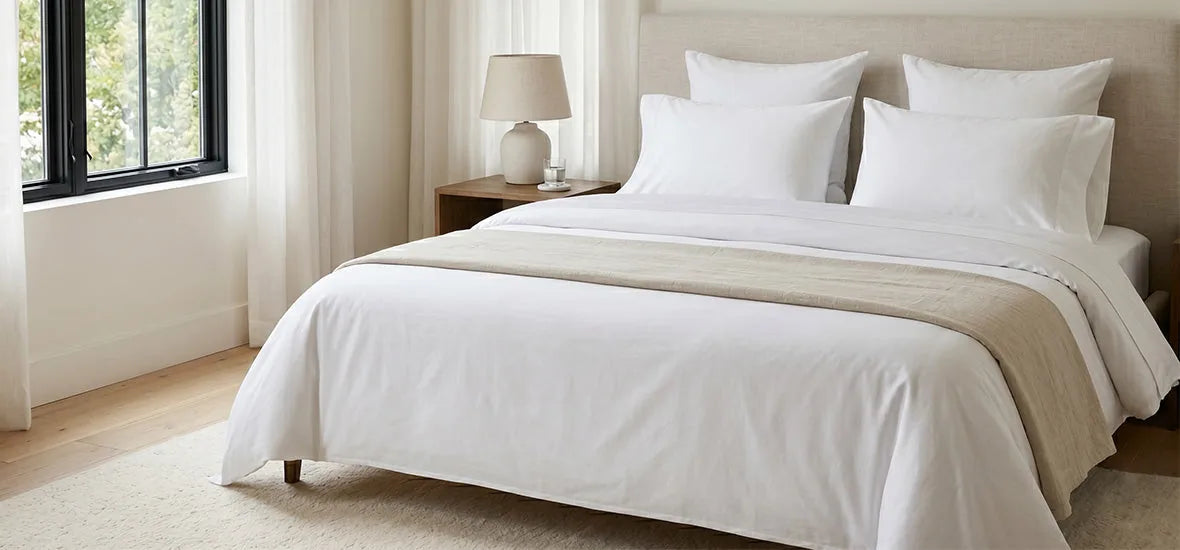

When it comes to bedding basics, few things create more confusion than top sheets and flat sheets. Customers ask us about them all the time- and honestly, it's not surprising. Bedding brands use both terms, stores label them differently, and most people never got a clear explanation to begin with.
So let's settle it once and for all.
Top Sheet vs Flat Sheet: Are They the Same Thing?
Yes- a top sheet and a flat sheet are the same item. The two terms are completely interchangeable. There is no difference between them.
Here's why the confusion exists: "flat sheet" describes what the piece of fabric is- a flat, rectangular sheet without elastic edges. "Top sheet" describes how you use it- layered on top of you while you sleep, between your body and your comforter or duvet.
Same product. Two names. Both are correct.

What are top sheets, exactly? A top sheet is a large, flat piece of woven fabric that lays over your body while you sleep. It's part of a standard sheet set alongside the fitted sheet (the one with elastic that wraps around your mattress) and pillowcases.
When you buy a California Design Den sheet set, here's exactly what you get:
- Fitted sheet- has elastic edges, wraps around your mattress
- Flat sheet / top sheet- no elastic, lays over you while you sleep
- Pillowcases- 2 standard/queen pillowcases in a 4-piece set, or 4 pillowcases in our 6-piece set
That's it. Simple, once you know the difference.

How to Use a Top Sheet Properly
If you didn't grow up using a top sheet- or if someone just handed you a sheet set and you've been wondering what to do with the big flat rectangle- here's exactly how to layer your bed the right way.
Step-by-Step Bed Layering Guide
Step 1: Fit the fitted sheet first. Pull your fitted sheet over all four corners of your mattress. Look for the head and foot tags on the sheet- they tell you which end is which, so you're not wrestling with it sideways. California Design Den fitted sheets use a full-perimeter elastic band (not just elastic at the corners), so the sheet stays anchored through the night.
Step 2: Place the flat sheet face-down. Set your flat sheet on the bed with the decorative side- the side showing the hem stitch detail- facing down toward the mattress. This way, when you fold the top back, the decorative hem faces outward, which is how hotels do it and why hotel beds look so crisp.
Step 3: Tuck or leave free. This one's personal. Tucking the bottom edge under the mattress keeps everything neat and secure. Leaving it loose is more relaxed and easier to get in and out of. Many people tuck one side but leave the other free. Try both and see what you like.
Step 4: Layer your duvet or comforter. Place your comforter or duvet on top of the flat sheet. For a classic hotel-style look, fold the top portion of the flat sheet back over the top edge of the comforter, about 8–10 inches.
Step 5: Add pillows. Place your sleeping pillows (in pillowcases) at the head of the bed. Add any decorative pillows or shams in front if you like that look.

The Hospital Corner Method
A hospital corner keeps the bottom of your flat sheet taut, hotel-style, without bunching or coming loose.
Here's how to do it: tuck the bottom edge of the sheet under the mattress. Then grab the side of the sheet about 16 inches from the corner, lift it straight up onto the mattress, and tuck the hanging part underneath. Then fold the lifted portion back down and tuck that under too. It sounds complicated in writing but takes about 20 seconds once you've done it twice.
Do You Really Need a Top Sheet?
This is one of the most searched questions in bedding, and the honest answer is: it depends on you.
There's no rule that says you have to use a top sheet. Millions of people don't, and sleep great. But there are real reasons many people swear by them. Here's both sides.

Why Using a Top Sheet Makes Sense
It protects your duvet and extends its life. A duvet insert or comforter is expensive, bulky, and hard to wash- most need a commercial-size washer. A top sheet creates a washable barrier between your body and your duvet, which means you can toss the sheet in your regular machine every week or two while your duvet stays clean much longer.
Think of it exactly like a pillowcase. You wouldn't sleep directly on a pillow without a pillowcase every night and wash the pillow weekly- the pillowcase protects it. Your top sheet does the same job for your comforter.
It gives you layering options throughout the night. If you get warm and want to kick off your heavy duvet but still want some coverage, a top sheet gives you a lighter option without being fully uncovered. It's a simple comfort tool.
It's a natural, breathable layer. A 100% cotton top sheet is a gentle layer against your skin- soft, natural, and comfortable. Many sleepers prefer the feel of a well-made cotton sheet to being directly under a heavier duvet.
Cotton top sheets get softer the more you wash them. This is one of our favorite things about natural cotton. Our Everyday Ease 400 and Weekend Soft 500 cotton sateen sheets are designed for frequent washing, and they genuinely get better over time.
Why Some People Skip the Top Sheet
Restless sleepers often find it frustrating. If you move a lot in your sleep, a top sheet can end up balled at the foot of the bed before midnight. That's a real reason to skip it, not just laziness.
It adds one more thing to launder. One more item to strip, wash, fold, and replace. For busy households, simplifying the bedding routine genuinely matters.
The Scandinavian-style bed is popular for good reason. Just a fitted sheet plus a duvet cover- no flat sheet in the middle. This style is clean, simple, and works beautifully. If you go this route, just plan to wash your duvet cover more frequently since it's in direct contact with your skin.

The verdict: Use a top sheet if you value the layering, love the feel of cotton against your skin, or want to protect your duvet. Skip it if you move a lot in your sleep, prefer simplicity, or find it bunches at night. Neither choice is wrong.
How to Fold a Flat Sheet Neatly
This is one of those things people either know or don't- and it makes a big difference in how your linen closet looks and feels.
The Standard Fold (for linen closets)
- Hold the sheet lengthwise and fold it in half, bringing the two long edges together.
- Fold in half again lengthwise.
- From one short end, fold into thirds or quarters until you have a neat rectangle.
- Smooth after each fold. That's it.
The Ranger Roll (for tight spaces)
- Fold the sheet in thirds lengthwise.
- Starting from one short end, roll it tightly toward the other end.
- Stand the roll upright in your linen closet- takes up minimal space.
The Pillowcase Trick
Store your full sheet set inside one of its own pillowcases. Everything stays together, nothing slides around the shelf, and finding the right set is instant. This is one of those small things that makes a big quality-of-life difference in a busy household.
What to Look For When Buying a Top Sheet
If you're shopping for a new set- or replacing just the flat sheet- here's what actually matters.
Weave: Sateen vs Percale
The weave of a sheet changes how it feels against your skin and how it drapes on your bed.
Cotton Sateen is woven with more threads on the surface, which creates a silky-smooth glide and a subtle luminous sheen. Sateen sheets drape beautifully and feel luxuriously soft. They're a favorite for top sheets because of how well they lay and how they feel against skin. California Design Den's sateen lines- from the 400 Everyday Ease through to the 1000 Grand Indulgence- all use this weave construction.
Cotton Percale has a matte, crisp finish that feels like a freshly pressed dress shirt. It's lighter in hand and airy in feel. Many people love percale specifically for the clean, structured way it lays on a bed. Our Egyptian Percale and Organic Percale sheets are woven this way.
Both weaves are excellent. It really comes down to personal feel preference- silky and smooth, or crisp and clean.
Thread Count

Thread count measures how many threads are woven per square inch. It's one factor in how a sheet feels.
- 400 TC (Everyday Ease)- Lightweight with a smooth, relaxed feel. A great everyday choice for a top sheet.
- 500 TC (Weekend Soft)- Featherlight with a soft, easygoing hand. Ideal for people who prefer a lighter layer.
- 600 TC (Restful Retreat)- Balanced and substantial. A smooth, inviting feel suitable for all seasons.
- 800 TC (Hotel Luxe)- A touch above midweight. The do-not-disturb density of a hotel stay.
- 1000 TC (Grand Indulgence)- Rich and substantial, with a soft, luxurious hand.
Each thread count delivers a distinct experience. Most people find their preference by starting in the middle and going from there.

Cotton Quality
All California Design Den sheets are 100% natural cotton. Our standard sateen lines use long-staple cotton fibers for a refined, durable weave. Our Egyptian Cotton lines use certified extra-long staple Egyptian cotton- verified by the Cotton Egypt Association's Accredited Gold Seal. Our Organic line is GOTS-certified organic cotton.
Certifications That Matter
Every California Design Den sheet carries OEKO-TEX® STANDARD 100 certification. Every item bearing this label is certified as having passed safety tests for harmful substances. It's a third-party verification we're proud to carry across our entire line.
Shop by Sleep Style: Which Top Sheet Is Right for You?
|
Sleep Style |
Best Pick |
|
Prefer silky-soft, smooth feel |
400 Everyday Ease Sateen or 500 Weekend Soft Sateen |
|
Like a slightly heavier, more substantial sheet |
600 Restful Retreat or 800 Hotel Luxe |
|
Love the hotel-level experience |
800 Hotel Luxe or 1000 Grand Indulgence |
|
Prefer crisp and clean, not silky |
Egyptian Percale or Organic Percale |
|
Want premium Egyptian cotton |
Egyptian Sateen or Egyptian Percale |
|
Prioritize certified organic fibers |
Organic Percale- GOTS certified |
Frequently Asked Questions About Top Sheets
Is a top sheet the same as a flat sheet? Yes- completely. Both terms refer to the same piece of fabric: a large, rectangular, non-elastic sheet that lays over you while you sleep.
Do hotels use top sheets? Most traditional hotels use both a fitted sheet and a top sheet as part of their standard bedding setup. The top sheet is part of what creates that tucked-in, crisp feeling at check-in.
Do I have to use a top sheet? No. Many people use just a fitted sheet and a duvet cover. If you prefer that simpler setup, it works great- just wash your duvet cover more frequently since it's directly against your skin.
What size top sheet do I need? Match your sheet size to your bed size. A queen flat sheet is made for a queen mattress; a king flat sheet for a king. For exact dimensions across all bed sizes, see our complete Bed Sheet Size Guide.
How often should I wash my top sheet? Most people wash their top sheets every one to two weeks. Since the top sheet is in direct contact with your skin, regular washing keeps it fresh and maintains the quality of the fabric.
Why does my flat sheet always end up at the foot of the bed? Two possible causes: the sheet isn't tucked securely at the bottom, or you move a lot in your sleep. Try hospital corners at the foot of the bed, which anchor the sheet more firmly. If bunching is still a problem, it might be a sign that a duvet-only setup suits you better.


