

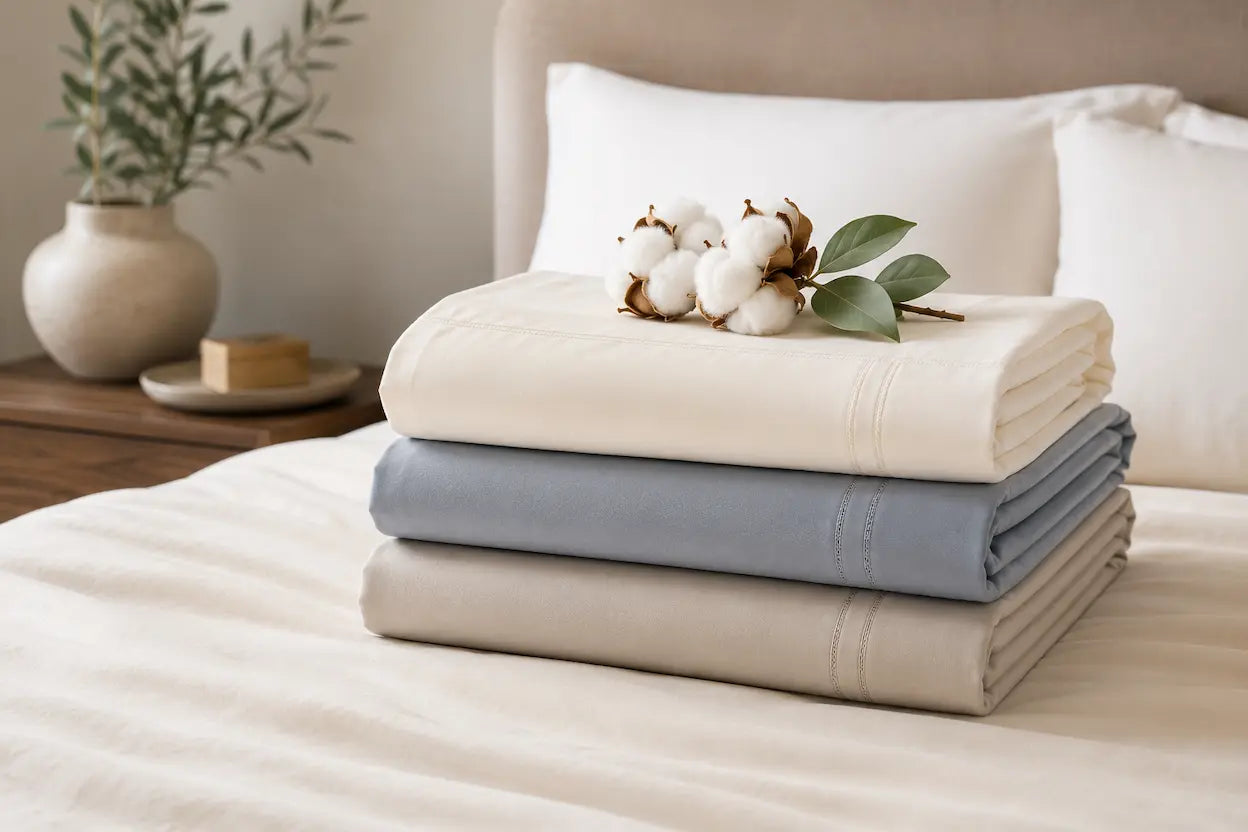
Are Egyptian Cotton Sheets Worth It? The Honest Answer
Yes, authentic Egyptian cotton sheets are worth it if you buy the real thing and pick the thread count that fits how you sleep. The extra-long fibers create a smoother surface, hold their shape wash after wash, and get softer with use instead of breaking down the way shorter-fiber cotton does. The catch is that a lot of what's labeled "Egyptian cotton" on store shelves isn't the real fiber, so the value depends almost entirely on authenticity rather than the name on the tag. If you want to see exactly how the fiber compares to standard cotton, the Cotton vs Egyptian Cotton Sheets guide breaks it down point by point.
For most sleepers, the price difference over a basic cotton set makes sense if you plan to keep the sheets for years rather than replace them every season. It matters less if you're furnishing a guest room you rarely use, and it matters more if you're the kind of person who notices texture the moment you climb into bed. Price alone tells you very little - plenty of overpriced sets use the same short-staple cotton as a budget pack, just with a higher markup.
This guide walks through what makes Egyptian cotton sheets different from regular cotton, how to tell real fiber from a marketing label, what to look for by thread count and weave, and how to care for a set so it actually lasts as long as it should.

Quick Answer: Are Egyptian Cotton Sheets Worth It?
- Yes, if it's authentic. Look for Cotton Egypt Association Gold Seal verification or a brand that names its sourcing directly.
- Fiber length is the real story. Extra-long staple (ELS) fibers, typically 34mm or longer, spin into finer, stronger yarn than short-staple cotton.
- Is Egyptian cotton good enough to justify the price gap? For daily-use bedding, usually yes - the fiber holds up to years of washing better than most alternatives.
- Thread count is a preference, not a ranking. A 400TC Egyptian cotton set can feel just as good as an 800TC set made from short-staple fiber, sometimes better.
- Weave changes the feel. Percale is crisp and matte; sateen is smoother with a soft sheen.
- Real Egyptian cotton gets softer with washing - it doesn't pill or thin out the way lower-grade cotton often does within the first year.
What Are Egyptian Cotton Sheets?
Egyptian cotton sheets are bedding made from cotton grown in Egypt's Nile Delta region, where the climate and soil produce unusually long cotton fibers. That extra length is what separates real Egyptian cotton sheets from ordinary cotton sheets - not the country name on the label, but the fiber itself, and how that fiber gets spun into yarn.
Where Authentic Egyptian Cotton Comes From
The Nile Delta's combination of warm days, controlled irrigation, and mineral-rich soil allows cotton plants to grow longer bolls than most other growing regions manage. Egypt has cultivated this variety for generations, refining the growing and harvesting process along the way. The Cotton Egypt Association now tracks and certifies genuine fiber with a Gold Seal and a DNA-verification program, since so much of what's sold globally under this name doesn't actually come from Egypt at all. Industry estimates suggest a large share of "Egyptian cotton" products on the market worldwide contain little to none of the actual fiber - which is exactly why authenticity checks matter more than the label.
What Makes the Fiber Different
Regular cotton fiber typically runs under 28mm in staple length. The genuine article is classified as extra-long staple (ELS), usually 34mm to 37mm or more. Longer fiber means:
- Fewer fiber ends poking through the weave, so the surface feels smoother against skin
- Finer, stronger yarn that resists pilling over repeated washes
- A denser, more even weave at the same thread count as a shorter-fiber sheet
- A fabric that softens with each wash instead of degrading or thinning
Why Are Egyptian Cotton Sheets So Good?
Is Egyptian cotton good, or is it mostly marketing? The honest answer sits somewhere in the middle - the fiber science is real, but it only delivers on that promise when the cotton is actually from Egypt and the spinning and weaving are done well. Poorly processed Egyptian cotton can feel no different from a mid-range cotton sheet, while a well-made set feels noticeably different within the first night you sleep on it.
Fiber Length and Why It Matters
Think of fiber length the way you'd think about thread in a sewing project. Short, choppy threads fray and break. Long, continuous threads hold together and drape smoothly. That's the entire reason this bedding has a reputation for feeling superior - the raw material itself is built for it, before a single loom is ever involved. Longer fiber also means fewer loose ends working their way to the surface, which is part of why the fabric feels smoother rather than fuzzy after a few washes.
Egyptian Cotton Sheets vs Regular Cotton Sheets
Here's where the two actually diverge in daily use:
|
Factor |
Egyptian Cotton Sheets |
Regular Cotton Sheets |
|
Fiber length |
Extra-long staple (34mm+) |
Short to medium staple |
|
Feel over time |
Softens with washing |
Can pill or thin out |
|
Yarn strength |
Finer yet stronger |
Coarser, more prone to breaking |
|
Price |
Higher |
Lower |
|
Authenticity risk |
High - frequently mislabeled |
Low - less often faked |
The price gap exists for a reason, but it only pays off if the fiber is what the label claims. If you want the full side-by-side breakdown, the Cotton vs Egyptian Cotton Sheets comparison covers weave, durability, and price in more depth than we can fit into one section here.
Why Should You Invest in Egyptian Cotton Sheets?
Investing in a set like this makes the most sense when you're buying for daily use, not for a special occasion. Bedding that gets slept on every night for years needs to hold its feel wash after wash, and that's exactly where the extra-long fiber earns its price difference over time.
Durability and Long-Term Value
A well-made Egyptian cotton sheet set can outlast several cycles of a cheaper set, which changes the actual cost-per-year even if the upfront price is higher. Consider what typically happens over three years of weekly washing:
- Short-staple cotton sheets often show pilling and visible thinning within 12–18 months of regular use
- Genuine long-staple fiber, properly cared for, tends to soften rather than degrade over the same stretch
- Replacing a cheap set two or three times can end up costing more than buying one long-lasting set upfront
- The fitted sheet's elastic typically wears out before the fabric itself does, so check the construction, not just the material
Cost-per-wear is a more honest way to think about the price tag than the sticker price alone. A $120 set that lasts five years works out to roughly $24 a year. A $50 set replaced every twelve months costs roughly $250 over five years - more than double the $120 set, without ever feeling as good along the way. That math is exactly why so many people who've tried both end up settling on long-staple cotton once they've done the comparison for themselves.
How to Tell If Your Egyptian Cotton Sheets Are Real
This is the part that actually determines whether the purchase was worth it. Because "Egyptian cotton" isn't a protected term everywhere it's sold, plenty of sheets carry the name without the fiber to back it up. A few signs to check before you buy:
- The listing names a specific certification, like the Cotton Egypt Association Gold Seal, rather than just repeating the brand name
- The brand discloses actual thread count and weave, not just a vague quality label with no numbers attached
- The price sits close to what genuine long-staple cotton actually costs to grow and process - a suspiciously cheap set claiming this fiber is a red flag worth taking seriously
- The fabric feels smooth and slightly heavy in hand, not stiff or papery straight out of the package
For a full checklist with specific things to look for on a product listing, the Fake vs. Real: How to Identify Authentic Egyptian Cotton Sheets guide is worth reading before you check out.

How to Choose the Best Egyptian Cotton Sheets
Once you've confirmed a set is actually what it claims to be, the next decision is matching thread count, weave, and fit to how you actually sleep - not to whatever number looks most impressive on the packaging.
Egyptian Cotton Sheets at 400TC vs 600TC
Thread count tells you how a sheet will feel and behave - it isn't a scorecard where a higher number automatically wins.
|
Thread Count |
Feel |
Best For |
|
400TC |
Light, crisp, everyday feel |
Warm sleepers, year-round use |
|
600TC |
Balanced, slightly denser |
Most sleepers who want a mid-weight set |
|
800TC |
Substantial, smooth |
Sleepers who prefer a heavier hand-feel |
|
1000TC |
Rich, thick drape |
Maximum density and weight |
Different thread counts offer different sleep experiences - choose based on how you like the fabric to feel against your skin, not just the highest number on the package. A 400TC set made from genuine long-staple fiber often feels better than an inflated, low-quality 1000TC claim.
Weave Type: Percale vs Sateen
Weave affects the feel as much as thread count does, and it's worth deciding on this before you shop by thread count alone:
- Percale uses a simple over-under weave. It has a crisp, matte finish and a more open, airy texture that many people prefer for everyday sleeping, especially if you tend to run warm at night.
- Sateen uses a weave where more yarn floats on the surface, giving it a smoother hand-feel and a subtle sheen that some sleepers find more comforting.
Neither weave is objectively better - it comes down to whether you prefer a crisp, matte hand-feel or a silkier one, and that's a personal preference rather than a quality question.
If you've never tried both, a good rule of thumb is to think about your favorite dress shirt versus your favorite T-shirt. Percale behaves more like the crisp cotton shirt - structured, matte, cool to the touch. Sateen drapes more like a softer knit - fluid, with a gentle sheen that catches the light. Trying a pillowcase in each weave before committing to a full set is a low-cost way to figure out which one you actually reach for at the end of a long day.
For a real-world percale example, the Signature Egyptian Cotton Percale Sheet Set – Bright White and the Signature Egyptian Cotton Percale Sheet Set – Mineral Blue both show the crisp, matte hand-feel described above, just in two different colorways.
Fit & Features to Check
Before buying, confirm these details against the actual product listing rather than assuming they'll match your bed:
- Pocket depth matches your mattress, especially for deep or pillow-top mattresses that standard fitted sheets often can't cover
- Elastic or corner construction on the fitted sheet stays put through a night of movement instead of popping off the corners
- The set includes the pillowcase count you actually need for your bed size
- Sizing is correct - a king-size Egyptian cotton sheet set needs a wider flat sheet and larger pillowcases than a queen set, and that's an easy detail to get wrong when shopping quickly
If you're comparing full sets rather than committing to a single size right away, browsing the Egyptian Cotton Sheets collection side by side makes it easier to compare thread count, weave, and color options in one place before you decide.
Color and finish matter more to day-to-day satisfaction than most buyers expect going in. A crisp white set shows less wear over time in photos but can also show staining more readily, while a deeper tone like a mineral blue tends to hide the small marks of daily use. Neither choice affects how the fiber performs - it's purely about what you want to look at every night and how the room is styled around it.
Caring for Your Egyptian Cotton Sheets
Good fiber only stays good with the right care. Bedding like this rewards gentle washing and punishes rough handling the same way any long-staple fabric does, regardless of how much it cost.
Washing and Drying Tips
- Wash in cool or warm water, not hot - heat breaks down fiber strength over time and speeds up wear
- Use a moderate amount of mild detergent; too much residue builds up and stiffens the weave
- Skip fabric softener, which coats the fiber and reduces its natural feel instead of improving it
- Tumble dry on low, or line dry to preserve the weave the longest
- Wash sheets separately from towels or anything with zippers or Velcro that can snag and pull at the fabric
How They Feel After Repeated Washing
This is the real test of whether a set was worth the price. Genuine long-staple cotton sheets typically feel a little softer after the fifth or sixth wash than they did straight out of the package, with no noticeable thinning or fraying at the seams. If a set starts feeling rough, pilled, or see-through within the first few months, either the fiber wasn't what the label claimed, or the care routine needs adjusting - usually the water temperature or the detergent amount. If you're still not sure which explanation fits, the Fake vs. Real: How to Identify Authentic Egyptian Cotton Sheets checklist is worth revisiting before you assume the worst about the fiber.
Why California Design Den Egyptian Cotton Sheets Stand Out
Feel is the first thing you'll notice with a good set of sheets, and that's where California Design Den's Egyptian cotton sheets are built to earn their price. The fabric has a smooth, substantial hand-feel that holds up night after night instead of thinning out in the wash after a handful of cycles.
That feel starts with the fiber. California Design Den sheets are made from 100% natural cotton - no synthetic microfiber, no plastic fibers - and the Egyptian cotton lines use the same extra-long staple fiber this guide has been describing throughout. So is Egyptian cotton good enough to build an entire collection around? California Design Den has bet on yes, sourcing sheet sets specifically to keep that fiber quality consistent set after set.
Signature Egyptian Cotton Percale Sheet Sets
The Signature Egyptian Cotton Percale Sheet Set – Bright White and the Signature Egyptian Cotton Percale Sheet Set – Mineral Blue both use a crisp percale weave with the open, airy texture percale is known for. Both colorways are also available across a wider size range through the Egyptian Cotton Sheets collection, including a dedicated king-size Egyptian cotton sheet set option for larger mattresses.
Backed by Trust You Can Verify
California Design Den has earned the Good Housekeeping Seal across its Egyptian cotton sheet sets, which means the products have been evaluated by an outside institute rather than resting on the brand's word alone. Paired with a family-owned facility that has produced cotton bedding for more than 20 years, and the 8 million+ sleepers who've already bought in, that adds up to a set of Egyptian cotton sheets you can check the receipts on - not just marketing copy claiming it's worth it.

FAQs About Egyptian Cotton Sheets
These are the questions that come up most often once someone has decided they're actually going to buy a set, rather than just browsing.
Are Egyptian cotton sheets better than regular cotton sheets?
Usually - the longer fiber feels smoother and holds up better over time than standard cotton, if it's the real fiber.
Can Egyptian cotton sheets go in the dryer?
Yes. Tumble dry on low heat to protect the fiber; line drying works too and can help the sheets last even longer.
What is the best thread count for Egyptian cotton sheets?
There isn't one best number. 400TC feels light and crisp; 600TC feels a bit denser. Pick based on feel, not the highest count.
Does 100% Egyptian cotton shrink?
A small amount of shrinkage is normal in the first wash or two. Cool water and low heat drying keep it minimal.
How do I know if my sheets are 100% Egyptian cotton?
Check for Cotton Egypt Association verification and a disclosed thread count - those two details separate real fiber from a marketing label.
Final Verdict: Are Egyptian Cotton Sheets Worth It?
Are Egyptian cotton sheets worth it? Yes - but only the real thing. The extra-long fiber actually changes how a sheet feels and how long it holds up, and that difference is noticeable within the first few nights and the first few washes, not just on a spec sheet. What isn't worth it is paying extra for a set that only borrows the name without the fiber behind it.
If you're shopping for a set, confirm the fiber source first, pick a thread count that matches how you actually like sheets to feel rather than the highest number available, and choose a weave - percale or sateen - based on your own preference rather than what a listing calls "best." Get those three right, and genuine Egyptian cotton sheets are one of the more reliable upgrades you can make to a bed you sleep in every single night.
Most people who ask this question already suspect the answer is yes - what they actually need is a way to separate a good set from an overpriced label. Now you have one: check the fiber, check the thread count against the actual feel you want, and pick a weave that matches how you sleep. Everything else is preference.


