

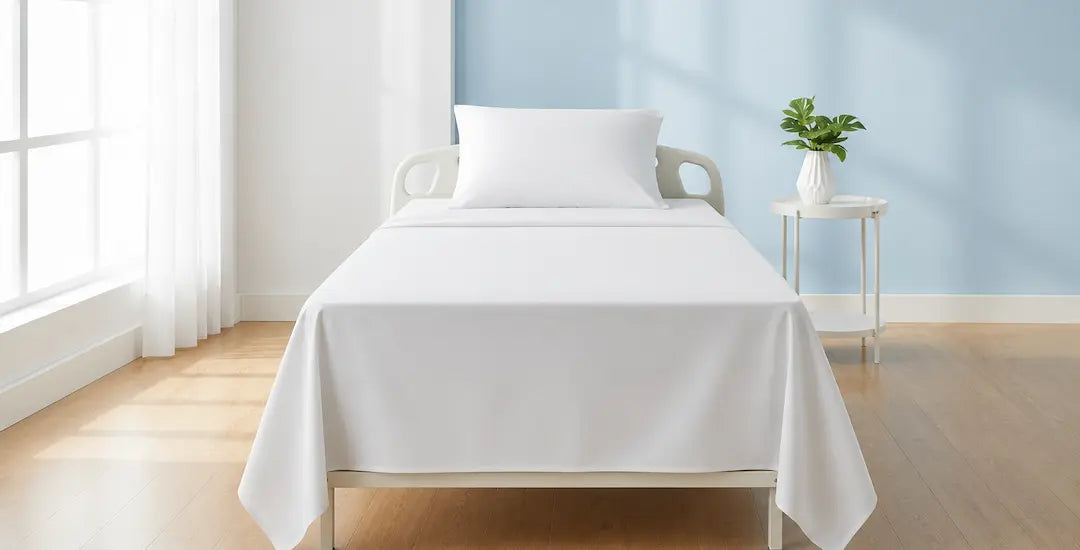
Twin XL Sheets for Hospital Bed: A Complete Fit Guide
Twin XL sheets for hospital bed will fit in most home care setups, since a standard hospital bed mattress runs close to the same footprint as a Twin XL mattress. The width is usually a little narrower on a hospital bed frame, so the fitted sheet sits with a bit more slack at the sides, but the length lines up almost exactly. If you're mapping out your options before you buy, our guide on What Are Twin XL Sheets? walks through the sizing basics in more depth.
That said, "close" isn't the same as "identical," and the difference matters more than it looks on paper. A fitted sheet that's too loose can bunch up, slide off the corners, or wrinkle under a patient overnight - not ideal for comfort or for keeping a bed looking tidy during care. Getting the pocket depth, elastic, and fabric right makes that setup work the way it should: secure, smooth, and easy to change.
This guide covers exactly how the sizing compares, what to check before you order, and which features actually make a difference for a hospital bed setup - whether it's a home care bed, a recovery bed, or an adjustable frame.

Quick Answer: Do Twin XL Sheets Fit a Hospital Bed?
- Length: A standard hospital bed mattress is about 80 inches long - the same length as a Twin XL mattress. No adjustment needed here.
- Width: Hospital bed mattresses typically run 36 inches wide, while Twin XL mattresses measure closer to 38–39 inches wide. They'll have a little extra fabric on the sides.
- Pocket depth: Hospital mattresses tend to be thinner (roughly 4–8 inches) than a home mattress, so a deep-pocket fitted sheet may need the elastic pulled snug to avoid excess fabric pooling at the corners.
- Fit fix: A fitted sheet with an all-around elastic gripper band (not just the corners) holds everything in place far better than sheets with corner-only elastic.
- Best pick: Cotton percale in a snug-fitting weave is easier to tuck and re-tuck than heavier fabrics, which matters if the sheets get changed often.
What Size Is a Hospital Bed Mattress?
Most home hospital beds are built around one standard mattress size, and it's smaller than people expect. A standard hospital bed mattress measures 36 inches wide by 80 inches long, with a thickness of roughly 4 to 8 inches depending on the model. Some extended-length versions run 84 to 88 inches for taller users, but 36×80 covers the majority of home care and recovery beds.
Bariatric and wider hospital beds exist too - some go up to 42, 48, or even 54 inches wide for patients who need more surface area. Those wider frames need their own sizing and generally won't work with a standard fit. This guide focuses on the standard 36×80 setup, since that's what most households and home care providers use.
Home hospital beds also vary in frame height and mattress thickness more than people expect. Frame height usually adjusts anywhere from 16 to 30 inches off the floor, and mattress thickness on a basic model tends to run thinner than a home mattress so the deck can raise and lower smoothly. Extended-length frames add up to 8 inches for taller users, and some hi-low adjustable models even offer wider decks for couples. None of that changes the width or length math above - it just means two hospital beds in two different homes can still call for slightly different mattress thicknesses.
Furniture-Style Adjustable Beds vs Institutional Frames
Not every hospital-style bed is an institutional frame. Furniture-style adjustable beds made for home use - the kind built to look more like a regular bedroom bed - are often built directly around standard mattress sizes, including Twin, Twin XL, Full, Queen, and even Split King. That's a meaningfully different situation from a true institutional frame, since the mattress deck is designed to match consumer sizing from the start.
- Institutional-style frames: Built around a specific deck size, usually 36 inches wide. The mattress needs to match the frame's interior dimensions closely to avoid gaps at the rails.
- Furniture-style adjustable beds: Built around standard mattress sizes. A Twin XL mattress and Twin XL sheets are usually the intended fit, not a workaround.
- Split-frame options: Some adjustable models offer two independent Twin XL sections under one Queen- or King-sized top, which lets each side of the bed adjust separately.
Knowing which category applies to your setup makes the sheet-buying decision much simpler. If the bed was designed around Twin XL from the start, sizing is simple and predictable. If it's an institutional frame, it's worth double-checking the deck's exact width before ordering.
Twin XL vs Standard Hospital Bed Size
|
Measurement |
Standard Hospital Bed |
Twin XL Mattress |
|
Width |
36 inches |
38–39 inches |
|
Length |
80 inches |
80 inches |
|
Thickness |
4–8 inches |
10–14 inches (varies) |
The length match is what makes this pairing workable in the first place. The width gap - usually just two to three inches - is small enough that a fitted sheet with good elastic can still hold its shape without sagging or sliding.
How Twin XL Sheets for Hospital Bed Fit the Mattress
Because hospital mattresses are thinner than a standard twin XL mattress, a deep pocket (12 inches or more) will have room to spare. That's not a problem on its own - it just means the elastic band around the fitted sheet has to do more of the work to keep things snug. If you're shopping for a set, browse the Twin XL cotton sheets collection and look specifically for full-perimeter elastic rather than corner elastic alone, since that detail makes the biggest difference on a narrower, thinner mattress.
Twin XL Sheets vs Hospital Bed Sheets: What's the Difference?
"Hospital bed sheets" isn't really its own separate product category for home use - it's a description of function, not a specific size standard. In most home care situations, those two labels usually mean the same thing, just sized to fit the closest standard mattress dimension available.
Institutional hospital sheets (the kind used in actual hospital facilities) are usually flat, non-fitted, and designed for fast, uniform changes across many beds. Home hospital beds don't need that level of standardization - they need sheets that fit well, stay in place, and are comfortable for one person to sleep on night after night. That's where a properly fitted sheet in this size comes in as the practical alternative.
Twin Sheets, Twin XL Sheets, and Hospital Sheets Compared
It helps to separate these three terms clearly, since they get used interchangeably online:
- Twin sheets - sized for a 38×75-inch mattress. Too short for most hospital bed frames, which run 80 inches long.
- Twin XL sheets - sized for a 38–39×80-inch mattress. This length matches a standard hospital bed almost exactly.
- "Hospital bed sheets" - a general term, not a fixed size. In home settings, this usually just refers to sheets sized this way, chosen because the length lines up.
The takeaway: twin sheets run short on a hospital bed, but the XL length solves that problem directly. If you already own a full-size bed elsewhere in the house and are wondering whether the same sheets can double up, our post on Will Twin XL Sheets Fit a Full Bed? breaks down why that swap doesn't work the other direction.
Why Pocket Depth Matters for a Hospital Bed
Pocket depth is the measurement most people skip and then regret. A fitted sheet's pocket depth needs to be shallow enough to grip a thin hospital mattress firmly, or deep enough with strong elastic to cinch down and hold its shape. Too much slack in the pocket and the corners start creeping up during the night or during a bed change - which is exactly the kind of small annoyance that adds up when sheets are being changed often.

How to Choose Twin XL Sheets for Hospital Bed
Picking the right set comes down to three things: pocket depth and elastic, fabric feel, and how easy the sheet is to handle during changes. None of these are complicated, but they're easy to overlook when shopping by price or print alone.
- Check the pocket depth listed on the product page - anything from 12 to 16 inches works for most hospital mattresses, as long as the elastic band runs the full perimeter.
- Favor a lighter-weight weave. A crisp percale weave is easier to tuck tightly and doesn't add bulk around a thinner mattress.
- Look for a fitted sheet with head and foot tags - small, but useful when sheets are being changed by someone other than the person sleeping in the bed.
- Confirm the flat sheet and pillowcases are sized to match, not just the fitted sheet, so the full set works together.
Laundering frequency is worth thinking about too. A home care setup often means sheets get washed more often than a typical bedroom - sometimes several times a week. That kind of routine wears down synthetic blends faster than natural cotton, which is one reason cotton percale tends to outlast other fabric options in this specific use case. A second full set on hand also makes same-day changes far less stressful, since one set can be in the wash while the other stays on the bed.
Checking Fitted Sheet Depth for Twin XL Sheets
A 15-inch fitted sheet pocket, paired with an anti-skid gripper elastic that runs the entire edge (not just the corners), holds its shape well even on a hospital mattress that's several inches thinner than a standard twin XL mattress. The Natural Organic Cotton Percale Sheet Set in Blue Hydrangea is built this way - a 15-inch deep pocket with an 18mm gripper band along the full edge, so the fitted sheet stays put through repositioning and regular changes.
Fabric Feel That Works Best for Hospital Beds
Percale and sateen behave differently once a sheet is on the bed. Percale has a crisp, matte finish with a lightweight, breathable hand-feel - closer to a freshly pressed dress shirt than a heavier fabric. Sateen has more drape and a smoother, silkier surface. For a hospital bed setup, percale tends to be the easier choice: it's simpler to tuck tightly, doesn't cling to itself when folded, and holds a crisp line at the corners, which matters when the sheet is being changed frequently.
Weight matters here too. A lighter percale weave is easier to lift and reposition around a patient than a heavier fabric, and it dries faster after washing - a small detail that becomes a bigger one when sheets are going through the laundry several times a week. None of this means sateen is a poor option; it simply asks a bit more patience during changes because of how the weave drapes and folds.
What to Look for When Buying Twin XL Sheets for Hospital Bed
Beyond size and fabric, a few smaller details separate a sheet set that works well from one that becomes a daily annoyance. These are the details worth checking before you order:
- Elastic type: Full-perimeter elastic outperforms corner-only elastic on a narrower hospital mattress. It's the single biggest factor in whether a fitted sheet stays in place.
- Weave: Percale for a crisp, easy-to-tuck feel; sateen for more drape and a smoother surface.
- Thread count: Higher thread counts feel denser and more substantial, while lower thread counts feel lighter and airier - neither is "better," it's a matter of preference for how the sheet feels against skin.
- Certifications: Organic cotton with GOTS certification means the fibers were grown and processed without synthetic pesticides - a detail some caregivers specifically look for.
- Color and print options: A hospital bed doesn't have to look clinical. The same construction that works for fit and durability comes in everyday colors and prints, like the Natural Organic Cotton Percale Sheet Set in Llama print, which uses the same 300-thread-count organic cotton percale build and 15-inch pocket depth as the solid colorways.
For anyone shopping by collection rather than a single set, the Twin XL cotton sheets collection groups options by weave and thread count, which makes it easier to compare pocket depth and elastic type across sets side by side. If a room needs a duvet cover or extra pillowcases to match, the Twin XL Bedding sets collection has coordinating pieces sized the same way.
Elastic and Grip for a Secure Fit
An all-around elastic band - not just elastic stitched into the four corners - is what keeps a fitted sheet from sliding on a mattress that's a couple inches narrower than the sheet itself. This one spec matters more on a hospital bed than almost anywhere else, since the width mismatch between a 36-inch mattress and a 38–39-inch sheet is exactly the gap that loose corner elastic fails to manage.
Material and Weave in Twin XL Sheets for Hospital Bed
Between percale and sateen, material choice comes down to feel and how often the sheets get handled. Percale's lighter, breathable weave is more forgiving when tucking around a thinner hospital mattress repeatedly, while sateen's heavier drape can bunch more easily under frequent changes. Either weave works structurally - this is a comfort preference, not a durability difference.
Why California Design Den Twin XL Sheets Work for Hospital Bed
California Design Den's sheets in this size are made from 100% natural cotton, with no synthetic fibers in the construction. That matters for a hospital bed setup specifically, since sheets in this context get washed and changed more often than average - natural cotton holds up to frequent laundering and gets softer with continued washing rather than breaking down.
100% Organic Cotton, No Synthetic Fibers
The Natural Organic Cotton Percale Sheet Set in Blue Hydrangea and the Natural Organic Cotton Percale Sheet Set in Llama print are both made from single-ply, 300-thread-count organic cotton yarns, with a 4-inch double-needle hem on the flat sheet and envelope-closure pillowcases. The fitted sheet's 15-inch pocket and 18mm anti-skid gripper elastic run the full edge, which is exactly the spec that helps them hold their shape on a narrower mattress.
Backed by the Good Housekeeping Seal
California Design Den's organic cotton percale sheet sets have earned the Good Housekeeping Seal, backed by a two-year limited warranty on covered products. Combined with GOTS certification on the organic cotton itself, it's a set built around durability and repeated washing - the two things that matter most when sheets are changed on a regular schedule. If you're outfitting more than one bed, the Twin XL Bedding sets collection covers matching sheet sets, duvet covers, and pillowcases sized the same way, so everything in the room stays consistent.
California Design Den is a family-owned brand, and that ownership structure is part of why the pricing on organic cotton percale stays reasonable even at 300 thread count. There's no markup layered on for a flashy brand story or a celebrity endorsement - just a cotton sheet set built to be washed often and to hold its construction through years of that use.

Frequently Asked Questions About Twin XL Sheets for Hospital Bed
Can you use twin XL sheets on a hospital bed?
Yes. Hospital bed mattresses run about 80 inches long, matching Twin XL length. Pick full-perimeter elastic for the snuggest fit on the narrower width.
What size sheet is a twin XL hospital bed?
A Twin XL sheet (38–39 by 80 inches) fits a standard 36-by-80-inch hospital bed mattress. The length matches; the width has a few inches of slack.
Are twin sheets the same as hospital bed sheets?
No. Standard twin sheets run 75 inches long - too short for an 80-inch hospital bed. Twin XL sheets match the length correctly.
What sheets are best for a hospital bed?
Cotton percale twin XL sheets with full-perimeter elastic and a 12–16 inch pocket depth. Percale tucks easily and holds a crisp fit through frequent changes.
Can you use fitted sheets on a hospital bed?
Yes. A fitted twin XL sheet with gripper elastic stays secure on a hospital mattress better than a flat sheet alone, especially during repositioning.
Final Thoughts on Choosing Twin XL Sheets for Hospital Bed
Twin XL sheets for hospital bed work in almost every standard home care setup, since the 80-inch length matches exactly and the width difference is small enough for the right elastic to handle. The details that actually matter are pocket depth, full-perimeter elastic, and a fabric that's easy to tuck tightly when sheets are being changed often.
Percale in a natural cotton build checks all three boxes - light enough to handle daily, structured enough to hold a clean line at the corners, and durable enough for repeated washing. It's also the combination that holds up best to the wash-and-change routine a home care bed usually runs on, week after week. Whether you're setting up one bed or several, matching the fitted sheet's construction to the mattress dimensions first will save more frustration than choosing by color or price alone. Chosen with those details in mind, this size holds up to exactly the kind of regular, everyday use it's meant for.


