

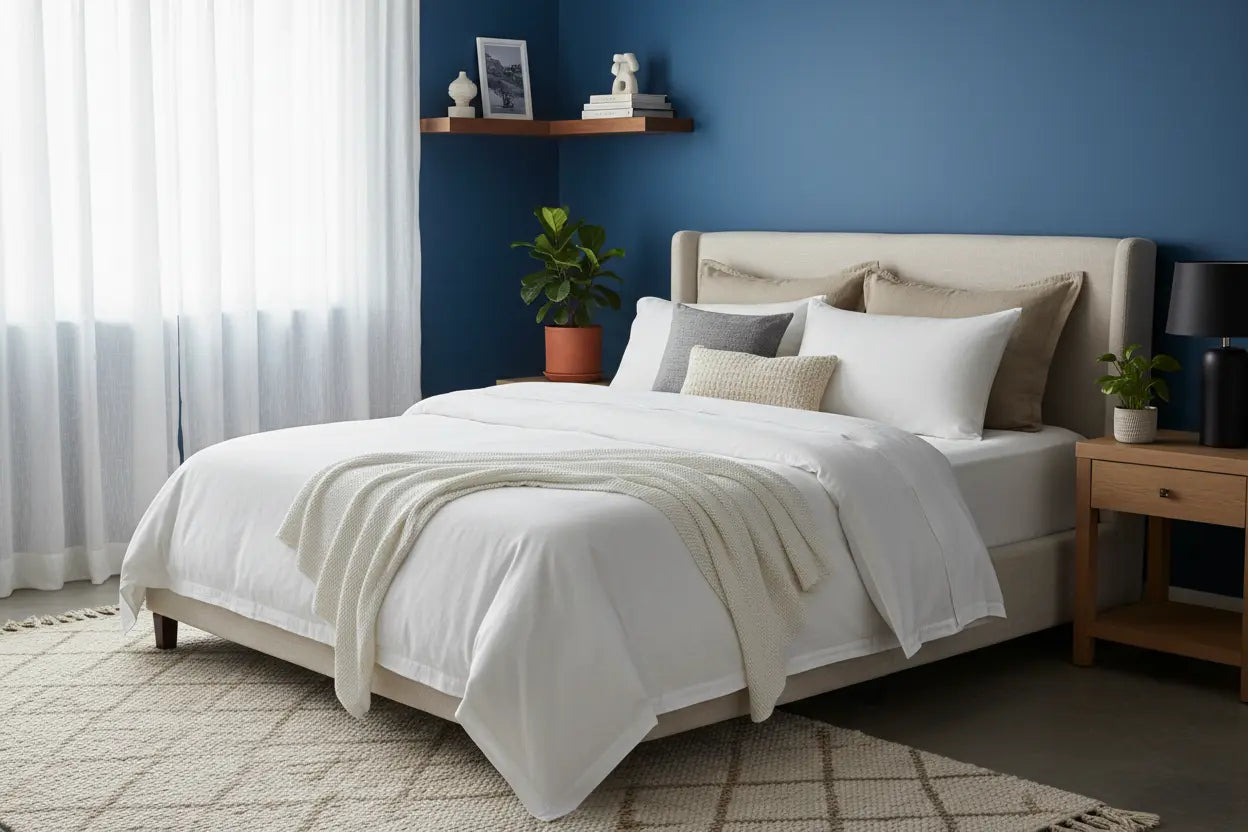
What Color Bedding Goes With Blue Walls? A Full Guide
The best colors for blue walls are warm neutrals like ivory, oatmeal, and soft grey, plus tonal blues in a lighter or darker shade than the wall itself. This mix keeps the room from feeling flat while still working with the color already on your walls. If you're also weighing sheet tones for other rooms, the What Color Bed Sheets Should You Get? guide is a useful starting point before you commit to one direction.
Blue is one of the easier wall colors to design around because it reads as calm rather than bold, so it pairs with almost anything from crisp white to a deeper navy. The trick with bedding for blue walls is choosing a tone that either contrasts gently or continues the same color family without matching it exactly. This guide walks through neutral pairings, tonal blue schemes, undertones, and texture, so you can land on a bedding color that actually looks intentional.

Quick Answer
If you only read one section, here's the short version:
- Warm neutrals (ivory, oatmeal, warm white, soft grey) work with almost any blue wall.
- Tonal blues - a shade lighter or darker than the wall - create a cohesive, restful look.
- Avoid matching the exact same blue on both the wall and the bedding; it flattens the room.
- Add texture (waffle weave, quilted details, linen-look cotton) so the palette doesn't feel one-note.
- Check your wall's undertone (cool vs. warm blue) before picking a bedding shade.
The Best Bedding Colors for Blue Walls
When people ask what color bedding goes with blue walls, the honest answer is that a handful of families do the heavy lifting: warm neutrals, tonal blues, and the occasional muted contrast color like blush or clay.
Warm neutrals are the safest starting point because they don't compete with the wall color. A cream or oatmeal duvet cover softens a saturated blue, while a soft grey sheet set works well against a paler, more washed-out blue. Neutrals also make it easier to swap in seasonal throws or pillows without redoing the whole room.
Tonal blues are the next most reliable choice. Picking a bedding shade a step lighter or darker than the wall gives the room depth instead of a single flat block of color. This is where CDD's Blue Bedding Sets come in handy - the collection spans several blue shades, so it's easy to land a step or two away from your exact wall color rather than an identical match.
A few other points worth knowing:
- Light blue walls generally pair better with slightly darker bedding, so the bed doesn't disappear into the wall.
- Deep navy or slate walls usually look better with a lighter bedding tone for contrast.
- Muted, dusty colors (blush, terracotta, sage) can work as accent pieces even if the main bedding stays neutral or tonal.
Neutrals Are Always a Safe Bet
If you're not sure where to start, neutral bedding is close to foolproof against blue walls. White, ivory, oatmeal, and soft grey all sit comfortably next to nearly every blue, from powder to navy.
Neutrals work because they let the wall color stay the visual anchor of the room. The bedding becomes a supporting layer rather than a second competing color. This is especially useful in smaller bedrooms, where too many colors can make the space feel busy rather than calm.
If your main question is really about matching sheets to a lighter or white-leaning look elsewhere in the room, the What Color Sheets Go with a White Comforter? guide covers that pairing in more detail, including how undertones shift a white comforter's appearance next to colored walls.
A practical tip: warm-toned neutrals (ivory, oatmeal, warm white) tend to soften cooler blues, while cooler neutrals (soft grey, dove white) tend to sharpen and modernize warmer, slightly greener blues.
Popular Color Themes for a Blue Bedroom
Beyond the neutral-versus-tonal decision, most light blue bedroom ideas fall into one of four recognizable themes. Knowing which one you're drawn to makes shopping for bedding much faster, since each theme points toward a different bedding color rather than a single "correct" shade.
Classic
The classic approach pairs a mid-tone blue wall with crisp white or ivory bedding, often with a navy or nautical-stripe accent pillow. It's a dependable look that works in almost any home style, from coastal to traditional. Adding a woven texture (matelassé-style or classic percale) keeps it from feeling flat.
Relaxed
A relaxed scheme leans on softer, muted colors: dusty blue walls with warm-toned linen-look bedding in oatmeal or sand. This theme favors slightly wrinkled, lived-in textures over a stiff, pressed look, and it tends to suit bedrooms that get a lot of natural light.
Analogous
An analogous scheme borrows colors that sit next to blue on the color wheel - think soft green, teal, or blue-violet. Instead of a single blue-and-neutral pairing, this theme layers two or three related colors so the room feels curated rather than matched. A set like CDD's Natural Organic Cotton Percale Sheet Set in a blue-hydrangea tone works well here, since it reads as blue with just enough violet undertone to bridge an analogous palette.
Monochromatic
A monochromatic bedroom stays in the blue family from wall to bedding, using different shades and textures instead of different colors. This is the trickiest theme to get right, since matching walls and bedding too closely can flatten the room. CDD's Blue Bedding Sets are built with this in mind - the range includes several distinct blue shades, so a monochromatic room can still have visual depth instead of one uniform tone.
Is Blue Bedding Too Much with Blue Walls?
Not necessarily, but it depends on execution. Blue sheets against blue walls can look flat and one-dimensional if the wall and the bedding are close to the exact same shade and finish. The fix isn't to avoid blue-on-blue altogether - it's to introduce a meaningful gap between the two shades, plus a change in texture or a supporting neutral.
A few ways to keep blue-on-blue from feeling like "too much":
- Choose a bedding shade at least two to three tones lighter or darker than the wall.
- Bring in a duvet cover with visible texture (waffle, matelassé, or a subtle woven pattern) rather than a flat, smooth finish that mirrors the paint.
- Add one neutral layer - a throw, a set of pillow shams, or a bed skirt - to break up the color block.
- If you want the safety of full color coordination, CDD's Blue Duvet Covers collection offers enough shade range to find a cover that complements rather than mirrors your wall color exactly.
What's the Undertone of Your Blue Wall?
Every blue wall color has an undertone - usually leaning cool (grey or green-based) or warm (violet or grey-lavender based) - and that undertone changes which bedding colors look right.
A cool-toned blue wall tends to pair best with crisp whites, cool greys, and other cool blues. Warmer neutrals like oatmeal can look slightly muddy against a strongly cool blue. A warm-toned blue wall, on the other hand, usually looks better with ivory, cream, and warm greige tones, since a stark cool white can feel harsh next to it.
If you're not sure which way your wall leans, hold a plain white sheet up against it in daylight. If the wall looks slightly greenish or grey next to the white, it's cool-toned. If it looks slightly purple or dusty, it's leaning warm.
This step matters more than it seems, because the same neutral can look completely different next to two blues with opposite undertones. An oatmeal duvet cover that looks warm and cozy against a warm-toned blue can look slightly dull against a cool, grey-based blue - while a crisp white that looks fresh against a cool blue can feel a little stark against a warmer one. Testing a fabric swatch or a single pillowcase against the wall before buying a full set is a simple way to avoid guessing.
Borrow Analogous Colors
One of the simplest ways to work with a blue wall's undertone is to borrow a neighboring color from the color wheel instead of going straight to a contrasting neutral. Soft green picks up a cool undertone nicely, while a dusty violet or mauve pairs well with a warmer blue. This is the same logic behind analogous color schemes, just applied at the undertone level rather than the whole-room level.
Introduce Different Textures
Texture does a lot of quiet work in a blue bedroom. A waffle-weave blanket, a quilted coverlet, or a percale sheet with visible weave all add depth without adding another color to track. Mixing a smooth sateen duvet cover with a more textured throw or woven pillow keeps a tonal or monochromatic room from reading as one flat surface.
Consider the Placement
Where you place color matters as much as which color you choose. A darker or bolder bedding color placed low (a duvet cover or bed skirt) grounds the room, while lighter accent colors placed higher (pillow shams, a folded throw) keep the space feeling open. If your blue wall is already a strong, saturated color, keeping the bedding placement simple - one main color, one texture layer, one accent - tends to look more intentional than several competing patterns.

What Color Bedding Goes With Blue Walls in Different Rooms
The right answer to what color bedding goes with blue walls also shifts a little depending on the wall's own depth of color. A pale, powder blue behaves differently in a room than a saturated navy, so it's worth treating the two situations separately rather than applying one rule everywhere.
What Color Bedding Goes With a Light Blue Wall?
A light or powder blue wall has a lot of headroom, since it's already close to white. Slightly deeper tonal blues, warm oatmeal, or even a soft grey all read as intentional rather than washed out. Because the wall is pale, a bolder accent color (navy piping, a terracotta throw) also has room to stand out without overwhelming the space. Avoid pairing a light blue wall with an equally pale, low-contrast bedding set - the bed can end up looking faded rather than calm.
What Color Bedding Goes With a Deep Navy Wall?
A deep or navy wall needs more contrast to keep the bed from disappearing visually. Crisp white, warm ivory, or a soft dove grey all lift the room and keep the bed as a clear focal point. If a full tonal look is preferred, a mid-tone blue bedding set - a few shades lighter than the wall - keeps the room cohesive without the flat, closed-in feeling that two near-identical dark tones can create in a smaller bedroom. CDD's Everyday Ease 400 Sateen Cotton Duvet Cover in Indigo Dusty Blue is a step lighter than most navy walls, which makes it an easy tonal match without disappearing into the paint.
A kid's or guest bedroom with a playful, lighter blue often has the most flexibility of all three: pastel accents, printed pillowcases, or a solid neutral base all work, since the wall color itself is doing less of the visual heavy lifting than a deeper, more dramatic shade would.
Guest rooms in particular are a good place to try one of the softer light blue bedroom ideas covered earlier, since a lighter palette photographs well and tends to suit a wider range of guests' tastes than a bold, saturated color choice would in a primary bedroom.
Caring for Your Colored Bedding
Colored bedding needs a little more care than plain white to keep its tone looking fresh over time. Wash in cold or warm water rather than hot, since heat fades dyed cotton faster. A gentle, dye-free detergent helps prevent the slow color shift that harsher detergents can cause after repeated washes.
Line-drying or a low-heat dryer setting also helps colored sheets and duvet covers hold their shade longer. If spills or stains are a bigger concern than color fading, the What Color Sheets Don't Show Stains guide breaks down which shades hide everyday marks best - useful if you're deciding between a light tonal blue and a deeper, more forgiving shade.
Rotating two bedding sets also extends the life of both, since each set gets less overall wear and fewer wash cycles per month. This is a simple habit that pays off most with darker or more saturated tonal blues, which tend to show wear and fading a little sooner than pale neutrals if they're washed every single week.
How to Choose the Right Bedding Color for Blue Walls
Once you know your undertone and preferred theme, narrowing down actual bedding for blue walls gets a lot easier. Work through it in this order:
- Confirm your wall's undertone (cool or warm) using the daylight test above.
- Pick a theme - classic, relaxed, analogous, or monochromatic - based on how much color variation you want.
- Choose a bedding shade that sits at least a step away from the exact wall color, whether that's a warm neutral or a tonal blue.
- Add one textured layer so the room doesn't read as flat or overly matched.
- Test swatches or samples in the room's actual light, since blue shifts noticeably between daylight and lamp light.
For most light blue bedroom ideas, a lighter wall pairs best with a slightly deeper bedding tone, while a deeper wall benefits from a lighter set to keep the room from feeling closed in. If you'd rather stay in a full-blue palette, CDD's Blue Duvet Covers collection is organized by shade, which makes it easier to compare a few options against your wall color side by side before deciding. And if the color question is really part of a bigger decision about sheet color in general, the What Color Bed Sheets Should You Get? guide is worth a read alongside this one.

Why California Design Den Bedding Works with Blue Walls
Choosing a bedding color is only half the equation - the fabric itself still needs to feel good to sleep in every night, whatever shade you land on. California Design Den sheets are made from 100% natural cotton - no synthetic microfiber, no plastic fibers.
The Natural Organic Cotton Percale Sheet Set in Blue Hydrangea is a good example - it carries an analogous, slightly violet-leaning blue that works well against both cool and warm wall tones, in a crisp percale weave.
California Design Den's cotton sateen sheet sets and duvet covers have earned the Good Housekeeping Seal, evaluated by the GH Institute - not just color and appearance. For a bedroom built around a specific blue palette, that's reassurance that the bedding will hold its color and shape wash after wash, not just look right on day one.
The Everyday Ease 400 Sateen Cotton Duvet Cover in Indigo Dusty Blue is one of the easiest tonal options for a blue bedroom - a deeper, dustier blue that pairs cleanly with lighter walls in a classic or tonal scheme. Most of our cotton sheets are made in our family-owned facility, which is why we keep pricing honest across our full color range, so building out a full palette of sheets, duvet covers, and shams doesn't require picking between color and value.
Between the two collections, most of the pairings covered in this guide - warm neutral, tonal blue, or a softer analogous shade - have a matching option to shop from directly, rather than needing to guess how a color will look once it's out of a swatch and on an actual bed.
Frequently Asked Questions About Bedding for Blue Walls
What bedding looks good with blue walls?
Warm neutrals (ivory, oatmeal, soft grey) and tonal blues a shade lighter or darker than the wall both work well with most blue walls.
What color complements blue walls?
Soft neutrals and analogous colors like muted green or dusty violet complement blue walls without competing with the paint.
Should your comforter match your walls?
No - an exact match can flatten the room. A tonal or neutral comforter usually looks better than a comforter in the identical wall color.
How do you add warmth to a blue room?
Add warm neutrals like oatmeal or cream, plus warm wood tones and soft textured throws, to balance a cool blue wall.
Which color complements blue the most?
Muted orange and terracotta sit opposite blue on the color wheel and complement it strongly as an accent, not a main bedding color.
Final Thoughts
There's no single right answer to what color bedding goes with blue walls, but there is a reliable framework: start with your wall's undertone, pick a theme that matches how much color variation you want, and choose a bedding shade that sits a step away from the wall rather than matching it exactly. Warm neutrals are the safest choice, tonal blues add depth, and a bit of texture keeps either approach from feeling flat. Whichever direction you choose, picking a cotton bedding set built to hold its color over time makes the palette worth the effort.


