

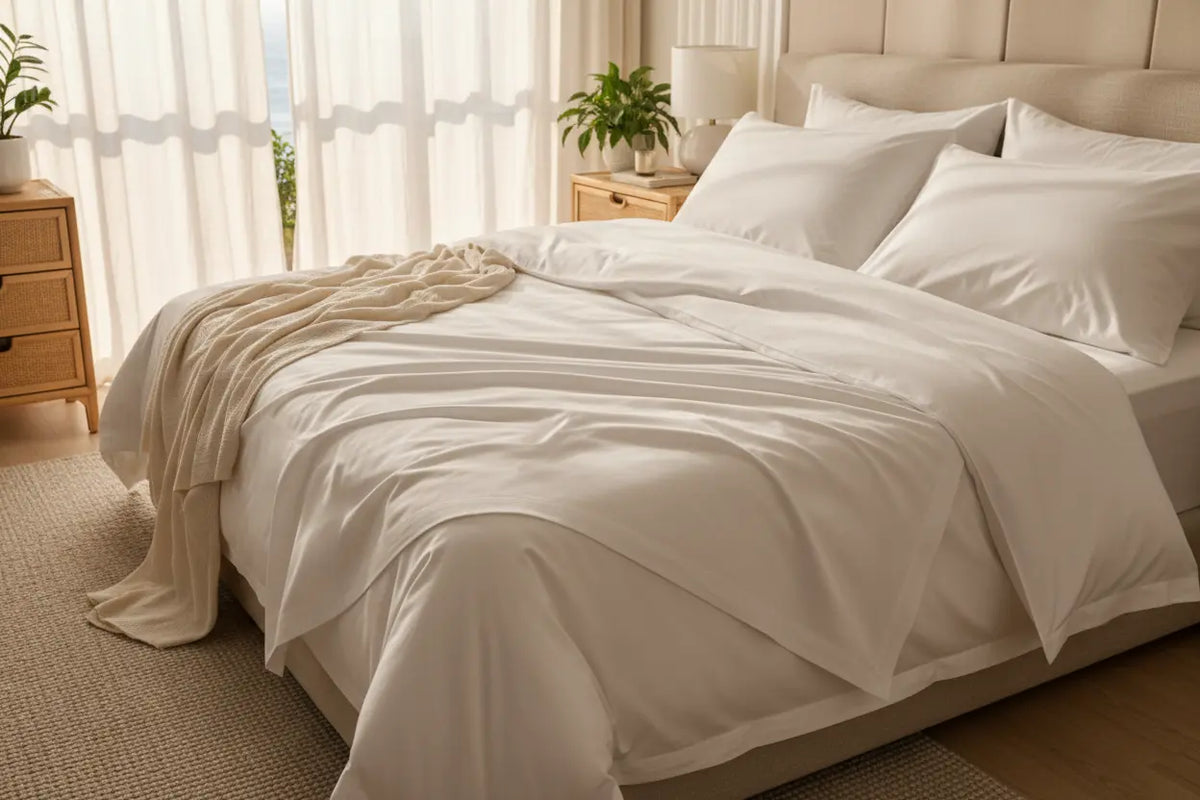
Top Sheet vs Flat Sheet: The Real Difference Explained
A top sheet and a flat sheet are the same physical item - the unfitted piece of fabric that goes between you and your comforter or duvet. "Top sheet" describes its job on the bed; "flat sheet" describes its shape in the package. Once you understand that, the top sheet vs flat sheet question stops being about two products and starts being about how and when to use the one you already have. Our What Are Top Sheets guide covers the basics if you want the short version first.
There's a reason this question comes up so often. Bedding brands list a "flat sheet" in the contents of a sheet set, but almost nobody calls it that once it's actually tucked onto the bed. At that point it's doing a completely different-sounding job, and the naming gap is where most of the confusion starts.
Quick Answer: Top Sheet vs Flat Sheet
There's no difference in the item itself. A flat sheet becomes a top sheet the moment you place it over your fitted sheet, underneath your comforter or duvet. Retailers use the word "flat" because that's how the piece is packaged and sold - unfitted, with no elastic corners, folded flat in the bag. You'll hear both names used interchangeably, and both are correct depending on which stage you're talking about.
- Top sheet - describes the role it plays once it's on the bed, sitting between you and your blanket
- Flat sheet - describes the product name on the shelf or inside a sheet set
- These aren't two different items. One word describes function, the other describes form, and a single piece of fabric carries both names depending on the sentence

What Is a Top Sheet?
So what is a top sheet, exactly? It sits directly on top of you, between your body and whatever you use for warmth - a duvet, comforter, or quilt. It's the layer that actually touches your skin most of the night, since a comforter usually doesn't. Anyone who's slept under a duvet cover with nothing underneath knows the texture difference right away - the cover fabric can feel rougher against skin than a soft cotton sheet, and stripping an entire duvet cover every week is a lot more laundry than washing one flat piece of fabric.
That's really the main reason people keep this layer in the rotation. It's far easier to wash a piece of cotton weekly than to wash a full duvet insert or a heavy comforter, which usually only needs cleaning a few times a year. This extra layer also adds breathing room between you and a heavier blanket, which matters if you tend to run warm at night - it feels lighter and lets air move more freely than sleeping directly under a duvet with no barrier at all.
What Does a Top Sheet Do?
A top sheet does three things on a bed, and none of them require anything fancy:
- Protects your comforter or duvet insert from body oils and sweat, so that heavier layer needs washing less often
- Adds a soft, breathable barrier between your skin and a thicker blanket
- Gives you a lighter option on warm nights, since you can sleep under just this one layer alone, no comforter needed
If you're weighing whether this step is worth adding to your bed, our Do I Need a Top Sheet? guide walks through the tradeoffs - cost, laundry frequency, and comfort - in more detail than we can cover here.
Two common approaches, depending on your household:
- Skip it, wash more often - some people leave this layer out entirely and just wash their duvet cover on a tighter schedule instead
- Keep it, wash less elsewhere - others prefer the extra layer specifically because it's the easiest single piece to strip off the bed on a Sunday morning, in and out of the machine in under an hour, versus wrestling a full duvet insert back into its cover afterward
Top Sheet Sizes and Fit
This piece needs enough overhang to tuck under the mattress at the foot of the bed and drape comfortably over both sides. Too small and it pulls loose by morning. Too large and it bunches under you as you move. Sizing follows your mattress dimensions - twin, full, queen, king, or California king - and should be paired with your fitted sheet size, not your comforter size, since comforters are typically cut wider. For a step-by-step tucking and folding method, the How to Put on a Top Sheet guide is worth reading before your next sheet change.
What Is a Flat Sheet?
So what is a flat sheet, if it's not the same thing as a fitted sheet? It's the unfitted rectangle of fabric that comes bundled in most sheet sets, alongside the fitted sheet and pillowcases. It has no elastic, no corners, and no shaping - just a hemmed edge on all four sides. Depending on the brand, one long edge often carries a slightly wider decorative hem, which is meant to fold neatly over the top of your comforter or blanket once it's in place.
Retailers use this particular name because it describes the shape rather than the use case - nothing about the word implies where it sits on the bed. You'll find it sold three separate ways: bundled inside a full Sheet Set, sold on its own for a straight replacement, or purchased as a matching pair if you want two different sizes for a guest room and a primary bedroom.
What Does a Flat Sheet Do?
- Sits between your body and your comforter, functioning as a top sheet the moment it's placed on the bed
- Can double as a lightweight cover on its own during warmer months, without a comforter layered on top of it
- Protects your duvet insert or comforter from nightly wear, extending how long that heavier layer stays fresh between washes
- Comes in a range of finishes - percale for a crisp texture, sateen for a smoother, more fluid drape
Some shoppers assume the fitted and flat pieces in a set are interchangeable sizing-wise. They're not. A fitted piece is cut to wrap snugly around mattress corners with elastic edging, while this one is cut flat and rectangular, with no stretch at all - which is exactly why it needs the extra overhang built into its dimensions.
Flat Sheet Sizes and Fit
Dimensions here run generously larger than the mattress itself, so there's enough fabric to tuck at the foot and drape over both long sides without pulling tight. Here's the actual size breakdown for two CDD options:
|
Size |
Flat Sheet Dimensions |
|
Twin |
66" x 100" |
|
Full |
84" x 96" |
|
Queen |
90" x 102" |
|
King |
112" x 102" |
|
Cal King |
108" x 106" |
These dimensions apply to both the Everyday Ease 400 Sateen Cotton option and the Restful Retreat 600 Sateen Cotton option - same generous cut, different weight and hand feel. If you're shopping specifically for a white piece to match an existing set, browse White Cotton Flat Sheets for options sized to this same chart.

Top Sheet vs Flat Sheet: Key Differences
Since these two terms describe the same object, "key differences" really means differences in how each word gets used - and where the confusion tends to creep in for most shoppers.
Top Sheet vs Flat Sheet: Purpose and Placement
- Top sheet refers to placement - it's the layer on top, right under your comforter, touching your skin all night
- Flat sheet refers to shape - it's the un-fitted piece, as opposed to the fitted sheet that wraps around your mattress corners
- A fitted sheet is never described with the word "top" - it goes under you, not over you, so the two terms never overlap
- Browse Flat Bed Sheets if you're replacing just this one piece rather than buying a full set
The mix-up usually starts at checkout. A product listing says "flat sheet." A bedding tutorial says "top sheet." Both are describing the exact same rectangle of fabric, just at different points in its life - one on the shelf, one already on your mattress.
Top Sheet vs Flat Sheet: Material and Feel
Cotton sateen and cotton percale are the two most common weaves you'll come across, and the weave changes how this piece feels more than anything else does.
- Percale - crisp, matte, cool-to-the-touch on first contact, gets softer with every wash cycle
- Sateen - smooth, subtly lustrous, drapes with a bit more weight and a gentle sheen
- Thread count - a selection tool, not a quality hierarchy; 400TC gives a lighter, everyday hand feel, while 600TC brings a slightly denser, more substantial one
Different thread counts offer different sleep experiences. Choose based on how you like the fabric to feel against your skin at night - not just the highest number printed on the tag.
Can You Use a Flat Sheet as a Top Sheet?
Yes - and this is the most common source of confusion in the whole top sheet vs flat sheet conversation. This piece becomes a top sheet the second you lay it over your fitted sheet and under your comforter. There's no separate product to go buy. If a sheet set includes this item, you already own a top sheet - you just haven't used that particular word for it yet.
When It Works
- Standard sheet sets are built with this exact use in mind - the flat piece is sized and hemmed specifically to sit on top and tuck at the foot of the bed
- Any weave works for this purpose: percale, sateen, or a blend, as long as the size matches your mattress correctly
- If you've never added this layer before, start with the one already sitting in a set you own before buying anything new - check the How to Put on a Top Sheet guide for the actual tucking technique step by step
When It Doesn't Work as Well
- A piece that's sized too small for your mattress won't tuck properly and will pull loose overnight, no matter how good the fabric feels in your hands at the store
- Pairing a lightweight weave with a very heavy comforter can cause bunching as you move through the night - sizing and hem quality matter more than which name is on the label
- If you're replacing a worn-out piece rather than buying a full set, Flat Bed Sheets lets you shop that single item without committing to an entire new set
So the short version holds up: this piece can always function as a top layer. Whether it fits your bed the way you want is a sizing question, not a naming one - and that's the distinction most shoppers are actually asking about when they type "top sheet vs flat sheet" into a search bar.
There's one more practical wrinkle worth mentioning: guest rooms. If you're making up a bed for visitors and only have one spare piece on hand, using it as a top layer is the more useful choice almost every time - guests notice a bare duvet cover far more than they'd notice a slightly mismatched pattern peeking out at the fold.

Why California Design Den Flat Sheets Stand Out
Whatever you call it, the piece that touches your skin all night should feel good against it. That's where the weave and the fiber actually matter more than the terminology debate.
California Design Den flat sheets are made from 100% natural cotton, with no synthetic fibers woven in anywhere. That matters for a piece of bedding you're in direct contact with for hours every night - cotton breathes on its own, softens with every wash, and doesn't need a synthetic finish layered on top to feel good against skin.
Both options here have earned the Good Housekeeping Seal, meaning they've been evaluated by the GH Institute for the claims made about them. That's a meaningful trust signal when you're buying bedding online and can't run your hand across the fabric before it arrives at your door. Every item also carries OEKO-TEX Standard 100 testing, which confirms the fabric has passed screening for harmful substances - one more thing you don't have to take on faith.
Everyday Ease 400 Sateen Cotton Flat Sheet
The Everyday Ease 400 Sateen Cotton Flat Sheet in White uses a softer, more relaxed weave than a standard cotton sateen. The result is a lightweight handfeel with a silky-soft glide - smooth, breathable texture that stays comfortable through everyday use, wash after wash. It's cut generously per the size chart above, finished with a clean 4" single pleat Z-hem.
Restful Retreat 600 Sateen Cotton Flat Sheet
The Restful Retreat 600 Sateen Cotton Flat Sheet in Sage Green brings a slightly denser, more substantial weight without ever feeling heavy. It has a smooth handfeel with a subtle luminous sheen, finished with a 4" double needle hem. Both options are single-ply, long-staple cotton - most of our cotton products are made in our family-owned facility, which is part of how we keep pricing honest without cutting corners on the fabric itself.
If you're outfitting more than one bed, the full Sheet Set collection bundles the fitted sheet, this flat piece, and pillowcases together in one order. Or shop White Cotton Flat Sheets on their own if you just need a single replacement piece rather than a full set.
Color and finish are worth thinking about too, not just weight:
- White - easiest to bleach and keep looking fresh over years of washing, a common choice for this particular piece
- Sage green - hides the occasional wrinkle better, a practical pick if you'd rather not iron before guests arrive
Neither choice affects how the fabric performs - it comes down to which upkeep routine fits your household.
How to Choose Between a Top Sheet and a Flat Sheet
Since you're buying the exact same item either way, the real decision comes down to weight, weave, and thread count rather than which name you use for it. A few starting points:
- If you sleep warm, look for a lighter, more relaxed weave - something like the Everyday Ease 400 Sateen Cotton Flat Sheet in White, built with an easygoing weave meant for everyday comfort
- If you want a bit more substance and a subtle sheen, a heavier sateen like the Restful Retreat 600 Sateen Cotton Flat Sheet in Sage Green brings a cozier, more balanced feel without added bulk
- Match the size to your fitted sheet, not your comforter - this piece should always be cut generously larger than the mattress itself, per the size chart above
- Consider hem style - a double needle hem sits flatter against the mattress edge, while a single pleat Z-hem adds a bit of texture right at the fold line
- Think about how often you wash bedding - a lighter weave dries faster, which matters if you're washing weekly rather than every other week
This is really a top sheet vs flat sheet decision in name only. What actually changes your sleep experience is the weave and the weight, not which word ends up on the product page.
Caring for This Layer
Washing habits matter as much as the initial purchase decision. A few practical notes:
- Wash in warm rather than hot water to protect the fiber's long-term softness - cotton sateen especially holds its sheen longer with gentler cycles
- Skip fabric softener if you can. It builds up on cotton fibers over time and actually dulls the smooth finish you paid for
- Tumble dry on low, or line dry if you have the space - high heat is the fastest way to wear down any cotton weave prematurely
- A light iron on the decorative hem edge keeps that fold-over line crisp if you like a made-bed look
None of this changes based on which name you use for the piece. Whether it's folded in a drawer labeled "flat sheet" or tucked onto the bed as your top layer, the same care routine applies either way.
FAQs About Top Sheet vs Flat Sheet
Do I really need a top sheet?
Not strictly, but it protects your comforter and adds a breathable layer. See Do I Need a Top Sheet?
Can you use a flat sheet as a top sheet?
Yes. It becomes a top sheet as soon as it's placed on the bed under your comforter.
Is a top sheet the same as a flat sheet?
Yes. Anyone asking what is a top sheet vs what is a flat sheet is really asking about one item, two names. See What Are Top Sheets
Is it okay to sleep without a top sheet?
Yes, it's personal preference. Some sleepers skip it and wash their duvet cover more often instead.
How long is too long without washing sheets?
Aim for once a week. A top sheet makes that easier since it's lighter to wash than a full duvet cover.

Conclusion: Top Sheet vs Flat Sheet
The top sheet vs flat sheet question comes down to one answer: they're the same piece of bedding, named for two different things. "Flat" tells you what it looks like on the shelf - unfitted, rectangular, hemmed on all sides. "Top" tells you what it does once it's actually on your bed, sitting between you and your comforter, night after night.
What actually changes your sleep experience isn't which word you use - it's the weave, the weight, and the fit. A relaxed 400TC sateen feels noticeably different from a denser 600TC weave, and getting the size right, matched to your mattress rather than your comforter, matters more than any label ever will. Once those two things are dialed in, whether you call it a top sheet or a flat sheet stops mattering at all - it's doing its job either way.


