

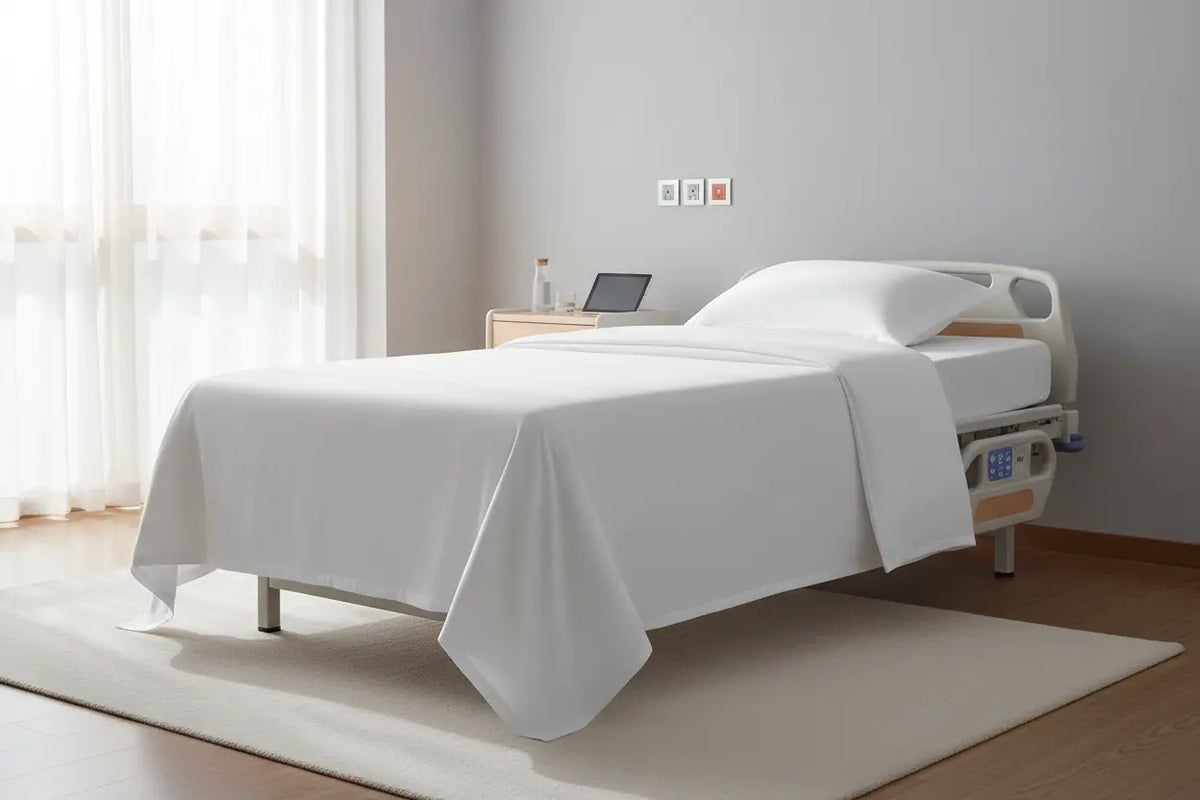
Types of Hospital Bed Sheets: A Complete Sheet Set Buying Guide
There are four main types of hospital bed sheets: fitted sheets, flat sheets, draw sheets, and pillowcases, and each one plays a different role in keeping a hospital bed clean, comfortable, and easy to change. Most hospitals and home caregivers rely on a sheet set that bundles these pieces together in a fabric and size built for narrow hospital mattresses. If you're shopping for a loved one at home or restocking a care facility, knowing what each piece does up front saves you from buying the wrong size twice.
This guide breaks down every hospital bed sheet type, which fabrics hospitals rely on most and why, how a sheet set differs from buying pieces separately, and how to pick a fabric and fit that will actually hold up to daily washing. You'll also find a full care guide, a step-by-step buying checklist, and answers to the questions caregivers ask most before ordering.
Here's what we'll cover:
- The main hospital bed sheet types and what each one does
- Which fabrics hospitals rely on most, and why that choice matters
- How a hospital bed sheet set compares to buying individual pieces
- Washing and care instructions that extend the life of your sheets
- A step-by-step buying guide for choosing the right sheet set
- Answers to the most-asked questions about hospital bedding
Quick Answer: What Are the Types of Hospital Bed Sheets?
The short version: hospital beds use fitted sheets, flat sheets, draw sheets (sometimes called lift sheets), and pillowcases. Fitted sheets wrap around the mattress and stay in place with elastic edges. Flat sheets lie on top, loose enough to tuck. Draw sheets sit across the middle of the bed and help caregivers reposition a patient without stripping the whole bed. A sheet set typically bundles a fitted sheet, a flat sheet, and one or two pillowcases sized to match a hospital mattress rather than a standard home mattress.
- Fitted sheet - wraps the mattress, elasticized edge, changed most often
- Flat sheet - top layer, tucked at the sides and foot
- Draw sheet - middle layer for repositioning and quick spot changes
- Pillowcase - matched to the sheet set fabric and thread count
Most hospital beds use a Twin or Twin XL frame, which is narrower and often longer than a standard home Twin. That's the detail that trips people up the most - a regular home sheet set frequently won't sit right on a hospital frame, since the corners and elastic are cut for a different mattress shape entirely. Our Twin XL Sheets for Hospital Bed: A Complete Fit Guide walks through exact measurements if you're not sure which size your bed needs.

The Main Types of Hospital Bed Sheets
Understanding the different hospital bed sheet types starts with knowing what job each piece is doing. A hospital bed isn't made up like a regular bed - it's built around a mattress that moves, so the sheets have to move with it without bunching, sliding, or pulling loose.
What Kind of Sheets Do Hospitals Use?
The honest answer to what kind of sheets do hospitals use is: it depends on the facility, but woven cotton and cotton-blend fabrics remain the standard, chosen for how well they survive frequent industrial washing. Hospitals typically prioritize:
- Fabric that survives repeated hot-water washing without pilling or thinning
- A weave that stays smooth under a patient who may be lying in one position for hours
- Elastic or fitted corners that don't pop loose during bed adjustments
- Consistent sizing across dozens or hundreds of beds, so replacement linens always fit
Woven cotton, particularly percale and sateen weaves, holds up to commercial laundering better than most synthetic blends. Some facilities use a poly-cotton blend for added durability, though a growing number of caregivers - especially at home - prefer 100% natural cotton for its breathable, easy-care feel and because it doesn't shed synthetic fibers the way blended fabrics can.
Fitted Hospital Bed Sheets
The fitted sheet is the piece that gets changed most, which is why fit and elastic quality matter more here than almost anywhere else in the linen closet. A good fitted sheet for a hospital bed should:
- Have an elasticized edge that runs the full perimeter, not just the corners
- Come in a deep-pocket cut that accommodates thicker hospital mattresses and any waterproof mattress cover underneath
- Hold its shape wash after wash, without the elastic going slack after a few cycles
- Stay smooth under a patient who may not be shifting position often
Our Hospital Bed Fitted Sheets collection is built specifically around these fit requirements, with sizing options that match hospital bed dimensions rather than assuming a standard home mattress.
Flat Sheets and Draw Sheets
Flat sheets are the loose top layer, tucked at the sides and foot to keep them in place through the night. They're simpler than fitted sheets, but a poorly sized flat sheet either won't tuck properly or leaves too much excess fabric bunching at the foot of the bed.
Draw sheets are the piece most home caregivers haven't heard of until they need one. A draw sheet is a smaller sheet - or sometimes a folded flat sheet - placed across the middle third of the bed under the patient. Its job:
- Gives caregivers something to hold onto when repositioning a patient in bed
- Can be changed quickly if it gets soiled, without stripping the entire bed
- Reduces friction and pulling on the fitted sheet underneath
Not every hospital bedding bundle includes a draw sheet by default, so if repositioning is part of daily care, it's worth adding one separately rather than assuming it's included.
Some caregivers also use a waterproof underpad in place of, or layered under, a draw sheet - particularly overnight or for patients who need extra protection between changes. An underpad isn't a substitute for a properly fitted bottom sheet, though; it sits on top of the fitted sheet and gets swapped out on its own schedule, which is usually more frequent than the rest of the bedding.
Hospital Bed Sheet Sets vs Buying Pieces Separately
A sheet set built for hospital beds bundles the fitted sheet, flat sheet, and pillowcase in matching fabric and thread count - and usually at a lower combined price than buying each piece on its own. But a full set isn't always the right call.
What's Included in a Hospital Bed Sheet Set
A typical hospital bed sheet set includes:
- One fitted sheet, sized and elasticized for the mattress
- One flat sheet, matched in fabric and finish
- One or two pillowcases, matched to the rest of the set
Pillowcases in a matched set usually come in the same fabric and thread count as the fitted and flat sheets, which keeps the whole bed looking and feeling consistent. That consistency matters more in a care setting than it might in a regular bedroom, since staff or family members restocking the bed don't have to think twice about which pillowcase belongs with which sheet.
Our Sheet Sets collection includes options built around these exact components, so the fabric, thread count, and finish match across every piece - something you don't always get when mixing and matching individual purchases from different sources over time.
When to Buy Pieces Separately
Buying individual pieces instead of a full set makes more sense when:
- The fitted sheet wears out faster than the flat sheet (common, since it's changed and washed more often)
- You need multiple draw sheets but only one flat sheet
- Budget means replacing the highest-wear piece first rather than the whole bundle at once
- You already have flat sheets and pillowcases you're happy with and only the fitted sheet needs replacing
For most home caregivers, a matched sheet set is simpler to keep track of and easier to reorder once you know which size and fabric works for your particular bed.

Care Guide for Hospital Bed Sheets
However well-made a set of sheets is, how you wash it determines how long it lasts. Hospital-grade laundering happens more often, and frequently runs hotter, than a typical home wash cycle, so the fabric and construction both need to hold up to that kind of repeat use.
Washing and Drying Hospital Bed Sheets
- Wash in warm water with like colors, on a gentle-to-normal cycle
- Avoid bleach on natural cotton fabrics - it breaks down fibers faster than a standard detergent would
- Tumble dry on medium heat, and remove the load promptly to prevent wrinkles and reduce the need for ironing
- Wash new sheets before first use - natural cotton softens with the first few washes rather than straight out of the package
- Rotate multiple sets if you're changing bedding daily, so no single set is doing all of the wear on its own
Cotton also tends to soften with repeated washing rather than break down the way some blended fabrics do, which is part of why it holds up over months of near-daily laundering.
How Often to Change Hospital Bed Sheet Sets
Most care settings change fitted and flat sheets daily, or immediately after any soiling. Draw sheets often get changed more than once a day since they take the most direct contact. If you're managing care at home, keeping at least two full bundles in rotation means one is always ready to go while the other is being washed and dried - and you're never caught without clean linens on hand.
Why California Design Den Works for Hospital Bed Sheets
A hospital or home-care bed only stays comfortable if the sheets hold up night after night - which is where California Design Den comes in. We make 100% natural cotton bedding, with no synthetic microfiber and no plastic fibers. Two of our fitted sheets are built around exactly the durability and fit needs covered in this guide.
Natural Cotton Fitted Sheets Built for Hospital Beds
Our Natural Organic Cotton Percale Fitted Sheet in White is a 300 thread count, single-ply, 100% organic cotton percale with a crisp, lightweight, breathable hand-feel and a deep-pocket cut designed for thicker mattresses. It's GOTS certified - organic cotton grown and processed to a globally recognized textile standard - and it was named Best Budget Friendly Fitted Sheet 2024 by US News.
For a softer hand-feel, our Everyday Ease 400 Sateen Cotton Fitted Sheet in White is a 400 thread count, single-ply, 100% natural cotton sateen with a smooth, relaxed weave and a deep-pocket build designed to stay put through repeated washing. It carries the OEKO-TEX® Standard 100 certification, meaning every component has been tested for harmful substances - a different credential than GOTS, but an important one if sheets are going through the wash daily.
A Set Backed by the Good Housekeeping Seal
Both the fitted sheets are backed by the Good Housekeeping Seal, meaning they've been evaluated against the Institute's standards for quality and durability. Combined with a deep-pocket, all-around elastic fit, they're built to handle the frequent laundering that any hospital bedding bundle goes through - without the fabric breaking down or the elastic giving out after a few dozen washes.
We're a family-owned business, and we price our sheets without the markup that comes from a middleman - which adds up when you're stocking more than one set to keep in rotation.

How to Choose the Right Hospital Bed Sheets
Buying hospital bed sheets isn't just about picking a color. Fit, fabric, and durability matter more here than they do for a regular bedroom, because these sheets get washed more often and used under more physical strain than an average home bed.
Matching Sheet Size to Your Hospital Bed
Most hospital beds use a Twin or Twin XL frame, but mattress depth can vary more than a standard bed - especially with add-on toppers or waterproof covers. Before ordering, measure:
- Length and width of the mattress itself
- Mattress depth, including any topper or waterproof cover stacked on top
- Whether the bed is a standard Twin or a Twin XL, since the extra 5 inches of length changes which set will actually fit
If you're unsure exactly what size you need, our guide on What Size Are Hospital Bed Sheets walks through standard hospital bed dimensions compared to home mattress sizes, so you can measure once and order the correct size the first time.
What to Look for in a Quality Sheet Set
- Deep-pocket fitted sheets that accommodate mattress toppers and waterproof covers without popping off the corners
- A durable elastic band running the full edge of the fitted sheet, not just at the corners
- Natural fiber content - 100% cotton breathes better and holds up to frequent washing without the fabric thinning out over time
- A weave suited to how the bed is used - percale for a crisp, lightweight feel; sateen for a softer, smoother hand-feel
- Consistent sizing across multiple sets, so replacement sheets from the same line always match what's already on the bed
Our Hospital Bed Fitted Sheets collection and full Sheet Sets range both cover these fit and fabric points, so you can compare a single fitted sheet against a full matched bundle before deciding which to order.
Choosing by Thread Count and Weave
Thread count is a selection tool, not a quality ranking - it tells you how sheets will feel and behave, not whether they're "good" or "bad." A 300–400TC range tends to feel lighter and crisper, which many caregivers prefer for beds that get washed daily, since lighter fabric dries faster between loads. Choose based on the hand-feel you want and how often the linens go through the wash, not just the highest number on the label.
Weave matters just as much as the number on the label. Percale is woven in a simple, tight over-under pattern, which gives it a crisp, matte finish that feels lightweight against the skin. Sateen uses a different weave - more threads pass over the surface before going under - which produces a smoother, subtly glossy finish with a softer hand-feel. Neither weave is "better" outright; the right one depends on whether you or the person in the bed prefers a crisp, fresh feel or a softer, more relaxed one.
For hospital and home-care beds specifically, both weaves hold up well to frequent washing when they're 100% natural cotton, single-ply construction. Blended fabrics can feel similar new, but they tend to pill and thin out faster under the kind of daily laundering hospital bedding goes through.
Comparing Deep-Pocket Fitted Sheet Options
If you're narrowing down which fitted sheet to order first, it helps to compare the two most common cotton weaves side by side:
|
Feature |
Percale Weave |
Sateen Weave |
|
Finish |
Crisp, matte |
Smooth, subtly glossy |
|
Hand-feel |
Lightweight, breathable |
Softer, more relaxed |
|
Best for |
Caregivers who prefer a fresh, crisp feel |
Caregivers who prefer a softer everyday feel |
|
Typical thread count |
300TC |
400TC |
|
Pocket style |
Deep pocket, full elastic edge |
Deep pocket, full elastic edge |
Our Natural Organic Cotton Percale Fitted Sheet in White and Everyday Ease 400 Sateen Cotton Fitted Sheet in White both fit this deep-pocket profile, so the choice comes down to which finish and hand-feel you'd rather have on the bed day to day.

Frequently Asked Questions About Types of Hospital Bed Sheets
What sheets are best for a hospital bed?
100% cotton, deep-pocket fitted sheets with full elastic edges. Percale feels crisp; sateen feels softer. Both should handle frequent hot-water washing well.
What are hospital sheets called?
Fitted sheets, flat sheets, draw sheets (or lift sheets), and pillowcases - together, the main types of hospital bed sheets used in most care settings.
Do hospital beds need special sheets?
Yes. Hospital beds run Twin or Twin XL with deeper mattresses, so regular home sheet sets often don't fit the corners or elastic properly.
What are the four main types of hospital beds?
Manual, semi-electric, fully electric, and low or bariatric beds. Bed type doesn't change sheet sizing - mattress dimensions do.
What are the different types of hospital bed sheets?
Fitted sheets, flat sheets, draw sheets, and pillowcases - each covering a different part of the bed on its own wash schedule.
Conclusion
Getting the types of hospital bed sheets right comes down to three things: the right pieces for the job, a fabric that survives frequent washing, and a fit built for a hospital-sized mattress. A fitted sheet, flat sheet, draw sheet, and pillowcase each cover a specific need, and a matched sheet set makes it easier to keep them consistent across multiple beds or repeat orders.
Whether you're outfitting a single home-care bed or restocking several, start with the deep-pocket fitted sheet - it's the piece that wears fastest and matters most for fit. From there, a full sheet set in 100% natural cotton, in either a crisp percale or a smooth sateen weave, will carry you through daily washing without the fabric or elastic giving out.
If you're stocking a single home-care bed, one full set plus a spare fitted sheet usually covers daily changes without over-ordering. Facilities managing multiple beds tend to do better buying a full sheet set per bed plus a couple of extra fitted sheets and draw sheets, since those two pieces wear out and need replacing before the flat sheets and pillowcases do. Measure your mattress first, and the right hospital bed sheets are an easy pick from there.


